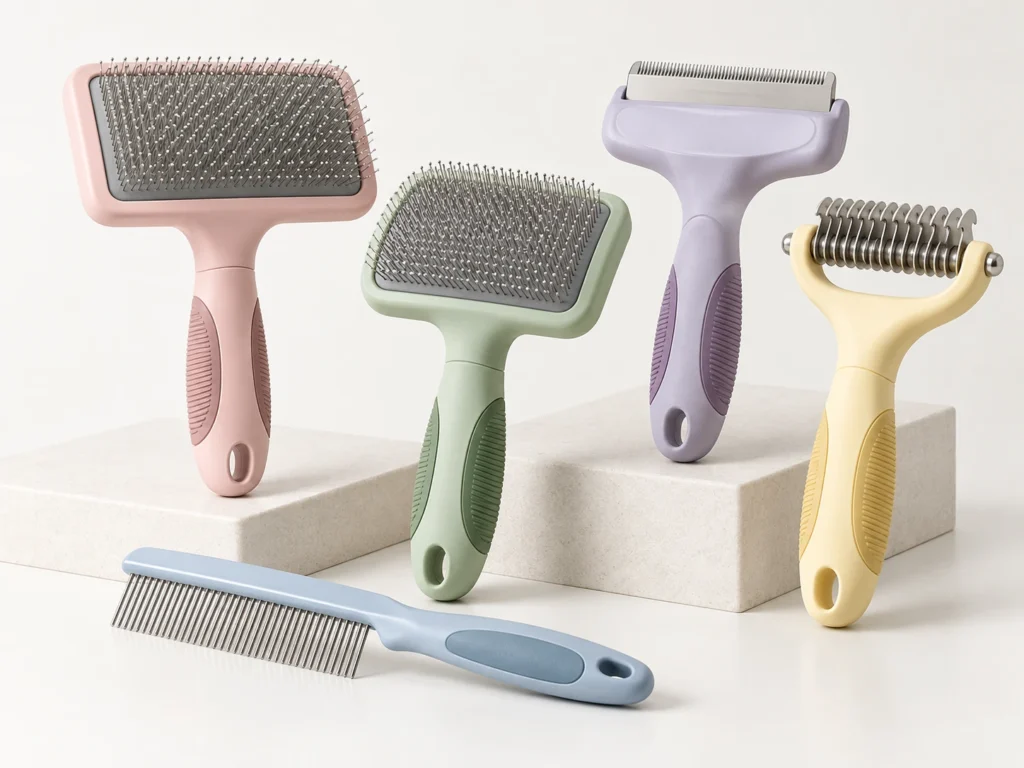
Slicker brushes and deshedding tools can both remove loose hair, so they are often compared as if they were two versions of the same brush.
They are not. A slicker brush is usually used for routine brushing, coat finishing, and light tangles, while a deshedding tool is more focused on loose shedding hair, with some designs reaching further into the undercoat.
For a pet grooming line, the useful question is not which tool is “better.” It is what grooming job the tool is meant to do, how the working head is built, and which coat types it is intended to cover.
What is the main difference between a slicker brush and a deshedding tool?
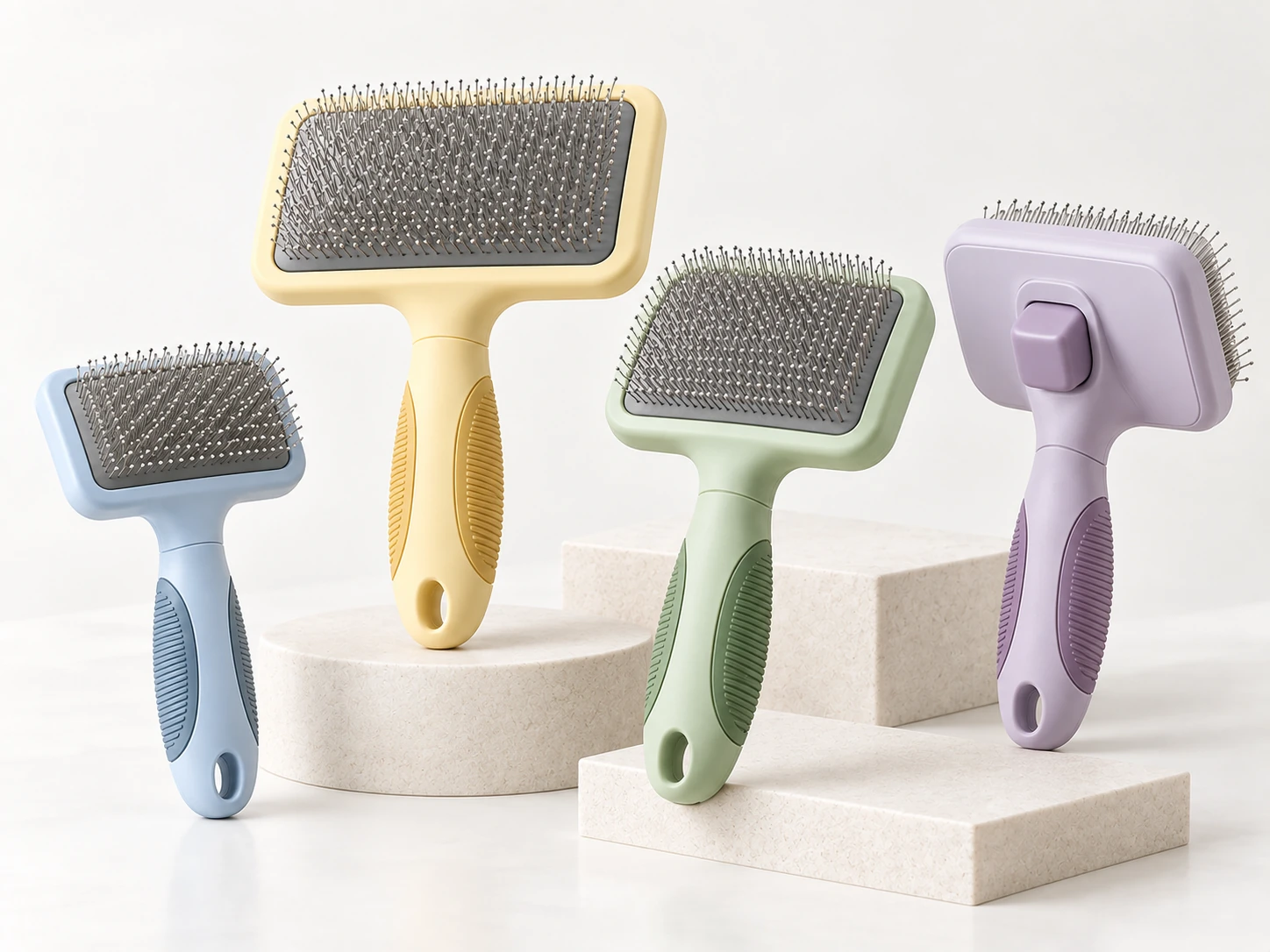
A typical slicker brush uses a dense field of fine pins so the brush works across a broader surface of the coat.
It is commonly used for routine brushing, collecting loose hair, tidying the coat, and working through light tangles. Pin length, pin density, firmness, pad shape, and brush-head size can all change how a slicker brush feels and where it fits in a product range.
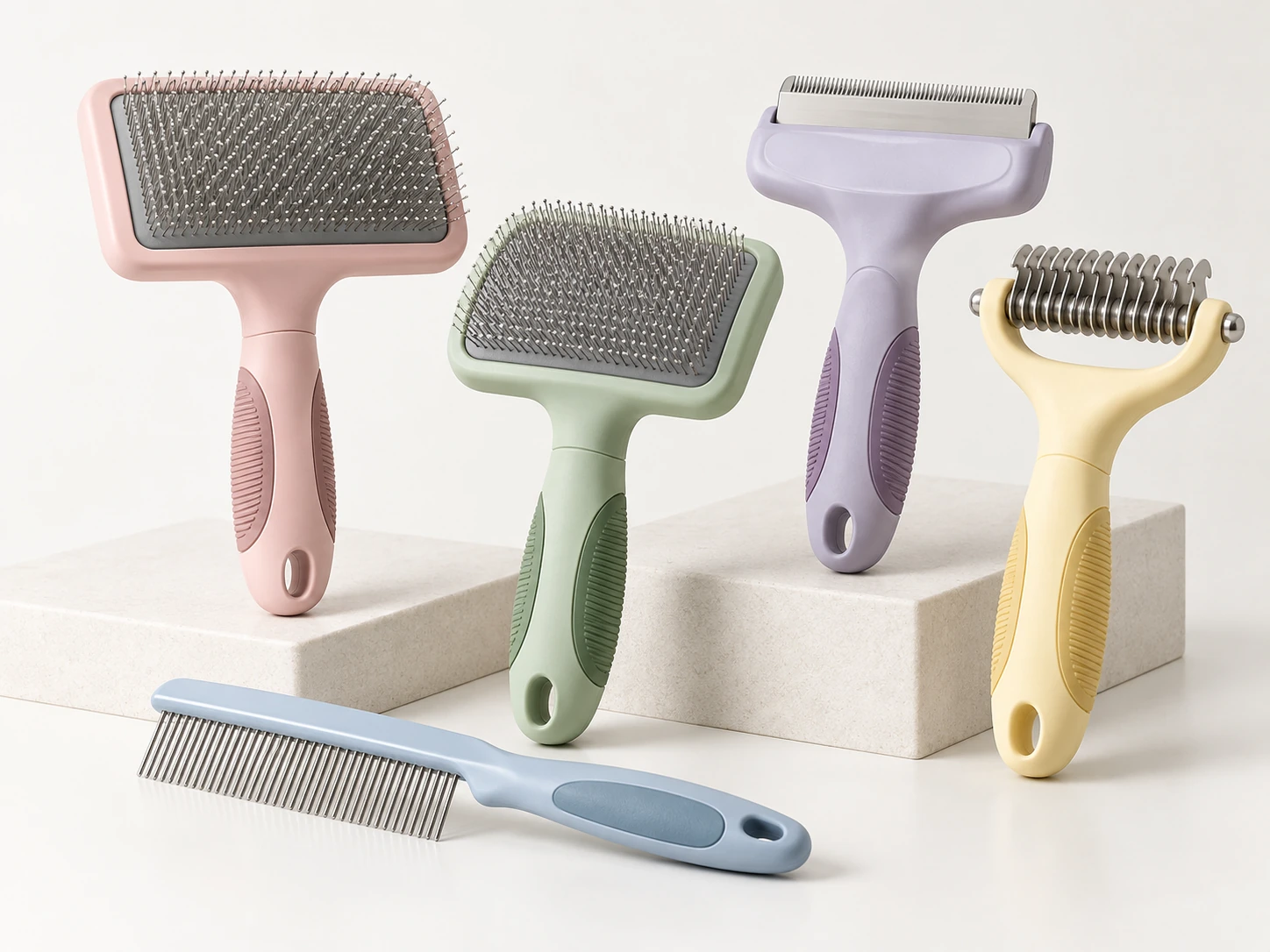
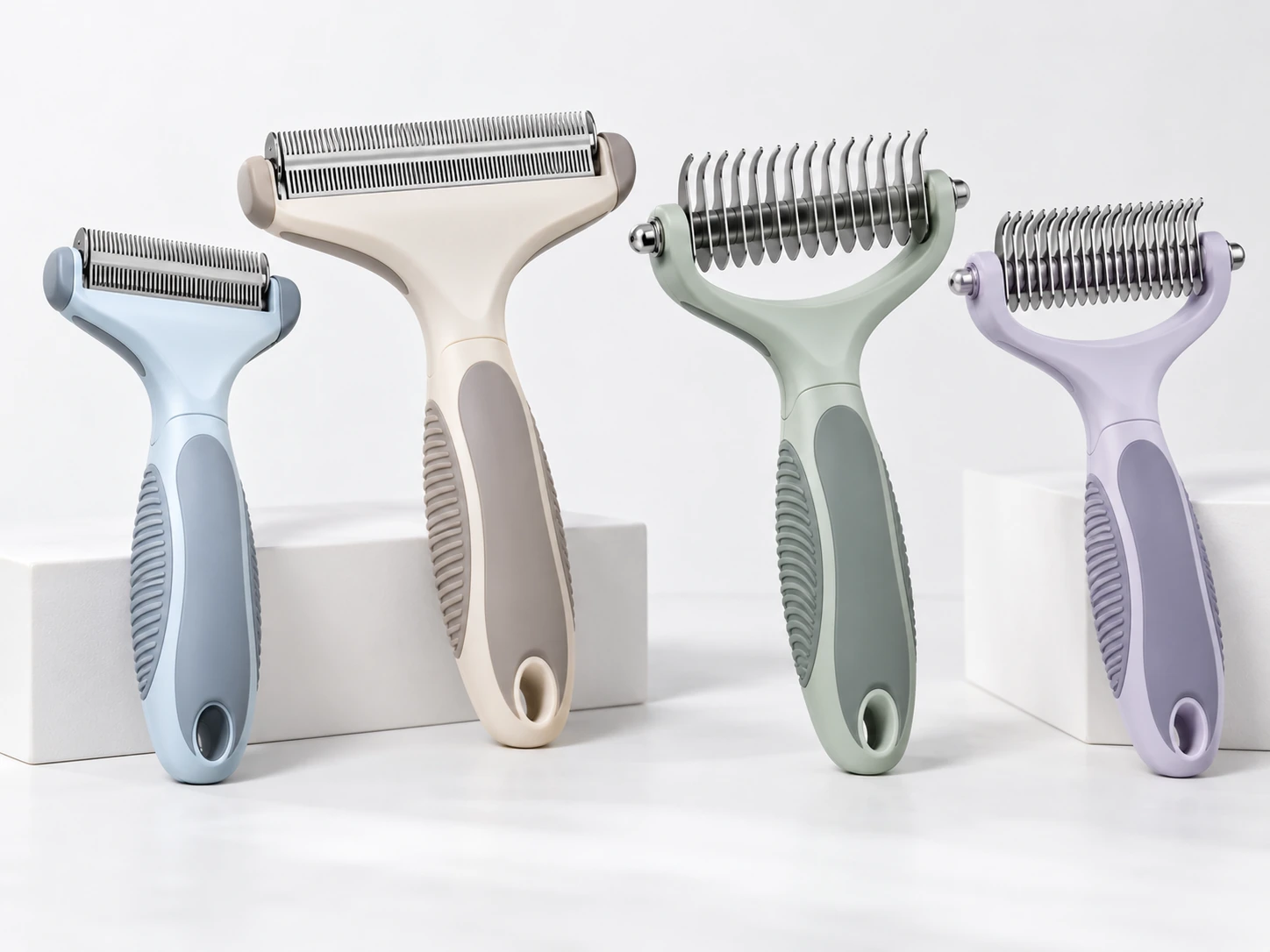
A deshedding tool usually takes a different approach. It uses metal teeth, an edge, or another working structure to collect hair that is already loose. Some products are aimed mainly at visible shedding, while others are designed to work further into a dense coat or loose undercoat.
“Deshedding tool” does not describe one single, standardized head design. Different products can use different tooth lengths, spacing, widths, and metal working surfaces, so the name alone is not enough to judge the tool.
| What to compare | Slicker brush | Deshedding tool |
|---|---|---|
| Common role | Routine brushing, loose hair, light tangles, coat finishing | More focused removal of loose shedding hair |
| Typical working head | Dense fine pins | Metal teeth, edge, or another deshedding structure |
| Product-line role | Routine coat-care tool | More specific shedding tool |
| Useful checks | Pin length, density, firmness, head size | Tooth or edge length, spacing, head width, coat reach |
The two categories can overlap in what they remove from the coat, but they should not automatically be treated as interchangeable products.
Do not rely on “slicker” or “deshedding” in the product name alone
Products sold under the same name can have noticeably different working heads.
A slicker brush may use shorter or longer pins, a softer or firmer pin bed, a flat or slightly curved head, different head sizes, or a self-cleaning mechanism.
A deshedding tool may also vary in tooth length, spacing, working-head width, and the way the metal section reaches through the coat. Some ranges also separate short-hair and long-hair versions.
A more useful purchasing check is therefore: what is the working head actually built to do with the coat?
For example, two suppliers may both describe a product as a “deshedding brush,” while one uses a compact metal deshedding edge and another is structurally much closer to an undercoat rake. Similar wording does not make the products the same.
A deshedding tool and an undercoat rake are not automatically the same thing
The names sometimes overlap in the market, but for product development it is clearer to return to the actual head structure.
An undercoat rake often has more obvious, longer rake-style teeth designed to reach through a thicker coat. Many deshedding tools use a more compact metal working head or a dedicated deshedding edge.
That is not a universal naming rule. Different brands may label similar structures differently.
Instead of forcing every product into a naming theory, make three points clear: what the working head is, which coat types it is intended for, and what grooming job it is expected to handle.
Coat type is usually more useful than breed name when choosing a tool
Retail pages often use breed examples because they are easy for shoppers to recognize. For product development, breed alone is less precise because dogs or cats within the same breed can still differ in coat length, density, and grooming needs.
It is usually more useful to start with the coat itself.
Short, smooth coats may not need a very long pin bed. Medium and long coats make pin length, brush-head size, and light-tangle handling more important. Curly or wavy coats can put more emphasis on pin arrangement and brushing depth. Dense coats with a clear undercoat may justify a separate tool focused on shedding or undercoat care.
This should not be turned into a rigid rule such as “one coat type must use one tool.”
The better question is whether the working head matches the coat and the grooming task the product is being designed for.
Can a slicker brush replace a deshedding tool?
There is no single answer that applies to every product.
If a range is mainly built around routine brushing, coat tidying, and light tangles, a slicker brush can take the central role.
If customers also need a tool for more noticeable shedding or loose undercoat, a separate deshedding tool can make the range easier to understand.
In a broader grooming line, the two categories can sit next to each other: the slicker brush handles routine coat care, while the deshedding tool has a more specific shedding role.
That is clearer than adding several brushes whose descriptions all sound almost the same.
See the current Slicker Brushes and Deshedding Tools pages when comparing the two product groups.
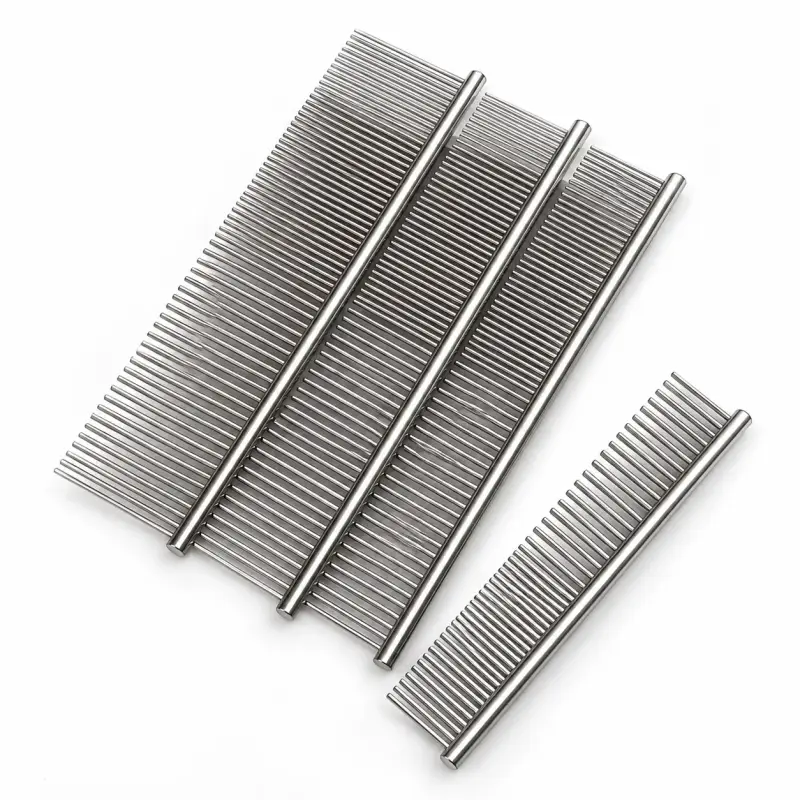
Pet Combs
Compare tooth spacing, comb formats, and handle styles before choosing the right comb mix for the range.
View Pet Combs →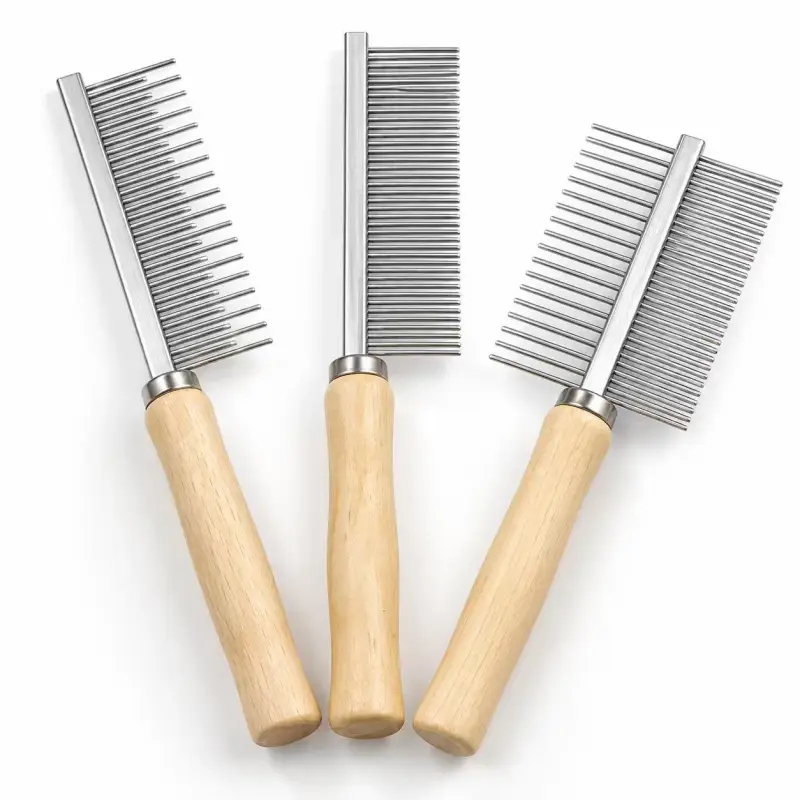
Grooming & Care
Review the current PETMERO grooming and care range before deciding how the comb products fit into the wider category.
View Grooming & Care →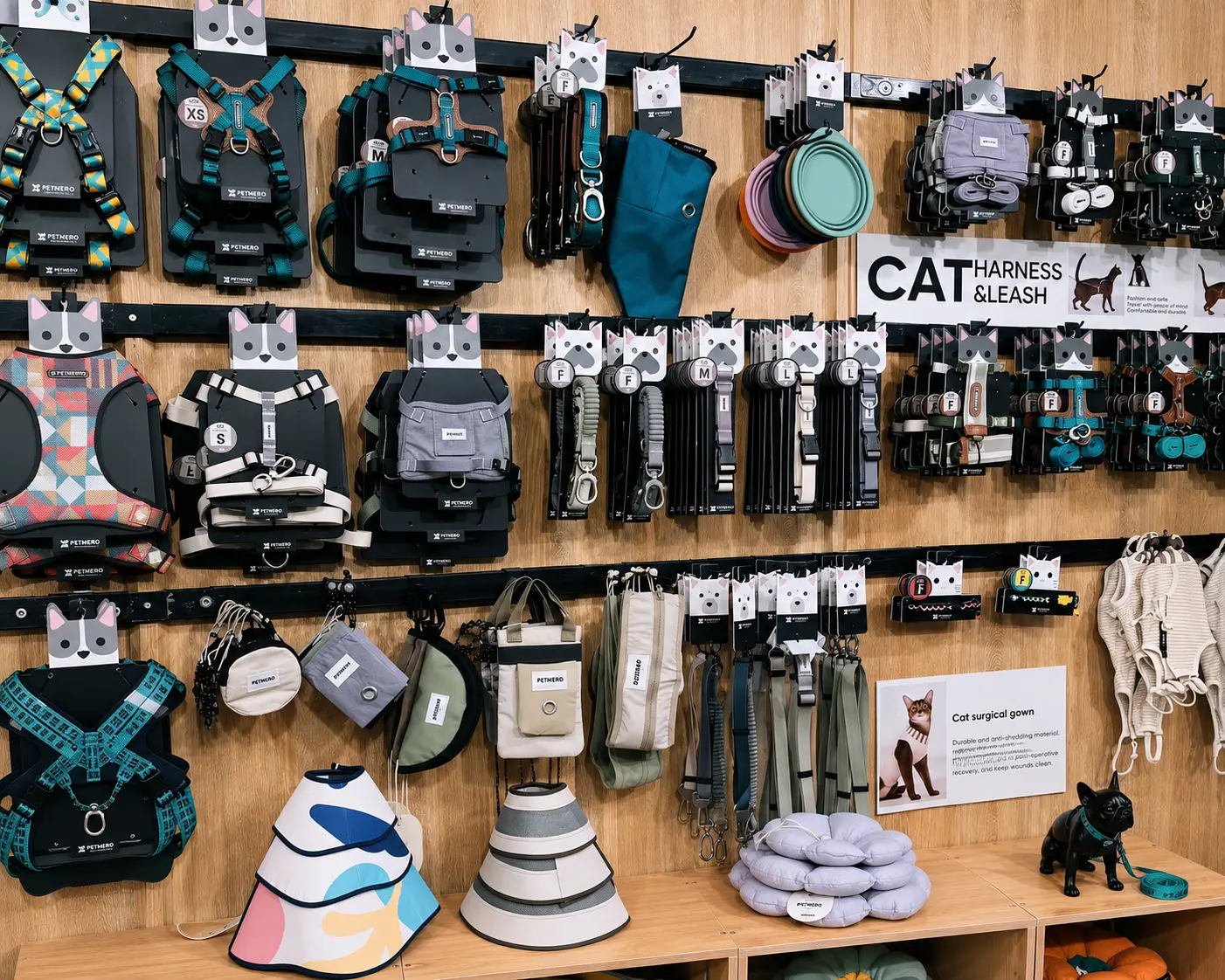
Customization
Once the working structure is clear, continue with color, logo, retail packaging, and other brand details.
View Customization →What should you compare between slicker brush designs?
A slicker brush does not need a long technical specification sheet to be useful, but several structural differences are worth checking.
Pin length
Different pin lengths change how far the pin bed reaches into the coat. If a range is intended to cover different coat lengths, changing only the color or packaging does not create a meaningful product difference.
Pin density and firmness
Density and firmness affect how the pin field meets the coat. More pins or a firmer pad are not automatically better.
Brush-head size
A smaller head is easier to control over smaller areas, while a larger head can cover more coat. If the range includes several sizes, each size should have a clear reason to exist.
Pad structure
Some slicker brushes use a pad with more flex, while others feel more fixed. This is better judged on a physical sample than from a product photo alone.
Self-cleaning function
A self-cleaning button mainly makes collected hair easier to remove from the pin bed. It is a convenience feature; it does not automatically change the basic grooming role of the slicker brush.
What matters most in a deshedding tool?
The working head is the main place to look.
Tooth or edge length affects how the tool reaches through the coat. Tooth spacing should be considered together with the intended coat rather than treated as a simple “finer is better” choice.
Working-head width also changes the product. Wider heads cover a larger area; narrower heads can be easier to control.
If a product range separates short-hair and long-hair versions, check whether the actual working heads support that distinction rather than relying on different packaging names.
If the tool includes a hair-release mechanism, review the button and moving parts on the finished sample to make sure they work smoothly.
Why final decisions should be made with complete samples
Images and specifications are useful for early selection, but they do not fully show how the finished tool comes together.
During sample review, useful checks include whether pins or teeth are aligned, whether there are obvious burrs or unusually sharp areas, whether the working head is secure on the handle, whether a self-cleaning mechanism moves smoothly, and whether the size differences in the range are actually clear.
If the final sample changes noticeably in pin layout, firmness, head geometry, or another working feature, the retail description, product positioning, and packaging copy should be updated as well.
The product name should follow the real structure, not force the finished tool to fit wording that was decided too early.
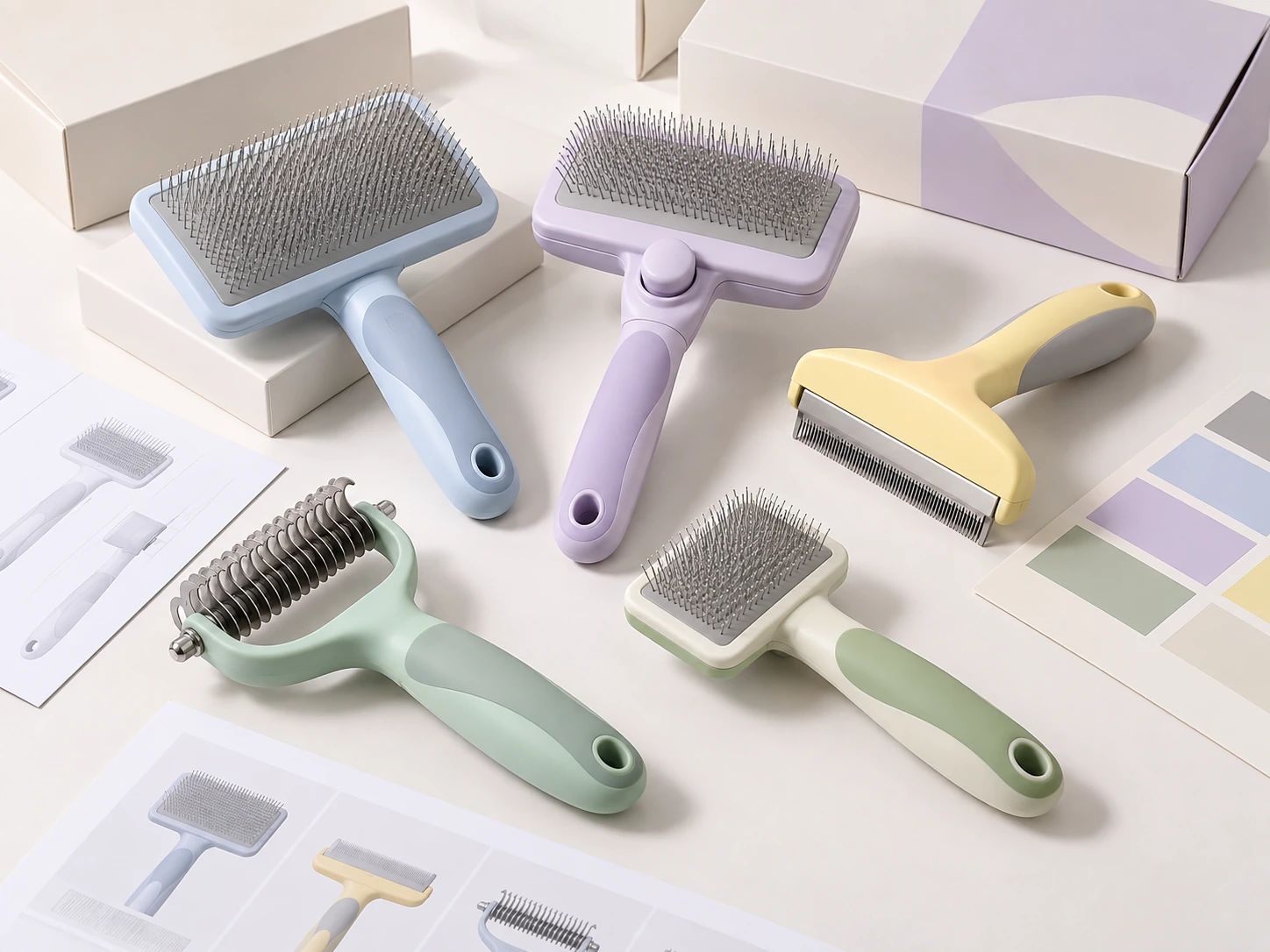
A complete grooming line does not need many overlapping SKUs
A clear grooming range can be built around different jobs rather than around the number of products.
A slicker brush can cover routine brushing. A deshedding tool can address more noticeable shedding. A comb or another complementary tool can then fill a separate coat-care role. Different sizes and self-cleaning versions can extend the range when they create a real difference for the customer.
What is worth avoiding is a group of brushes that are almost identical in structure and use, with only the color, packaging, or product name separating them.
For the shopper, that makes the choice harder. For the brand, it creates extra SKUs without adding a clear product role.
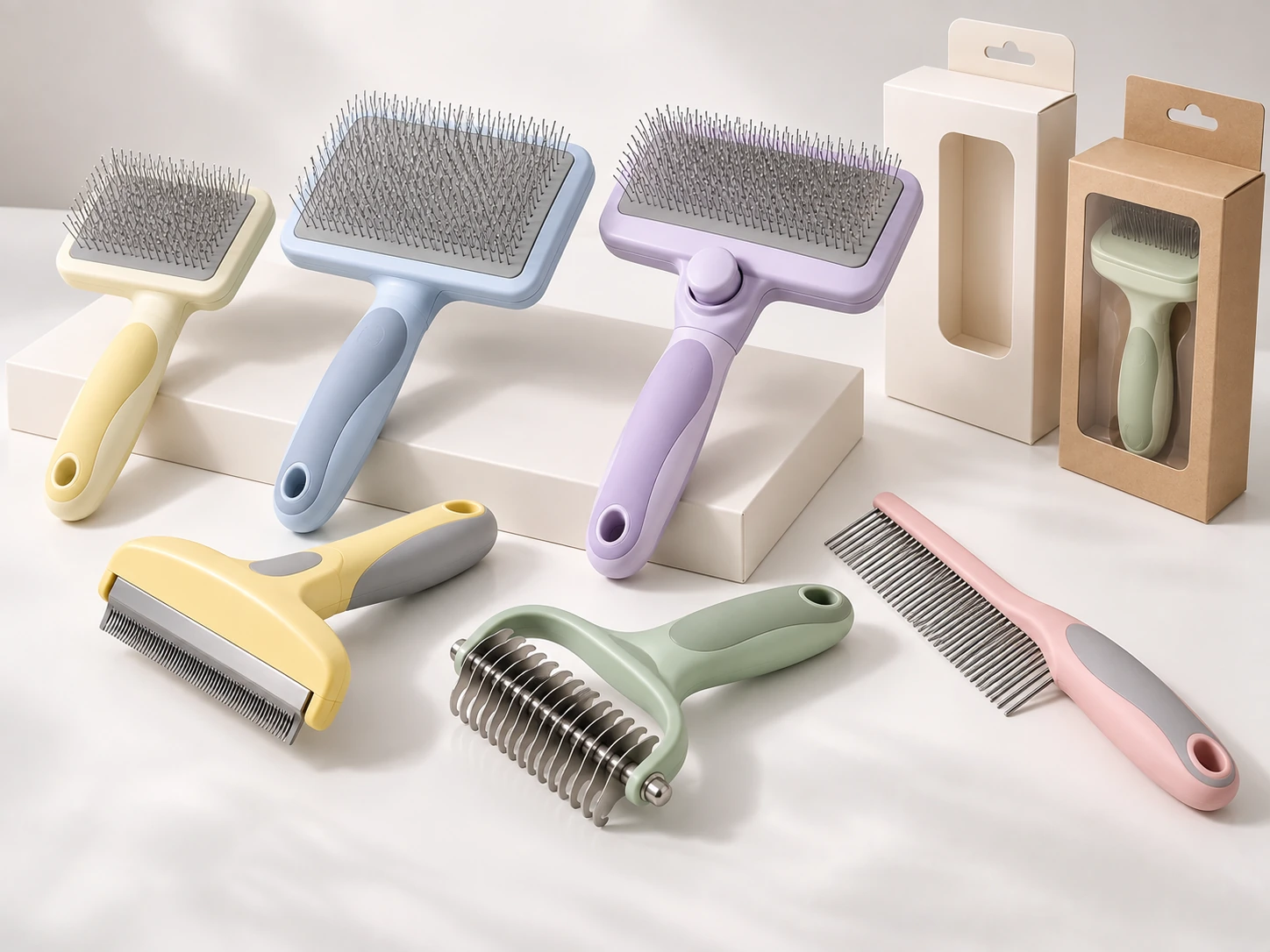
Packaging claims should match the actual tool
Slicker brushes and deshedding tools are both easy to oversimplify in retail copy.
Claims such as “suitable for all coats,” “removes all loose hair,” “stops shedding,” or an unsupported fixed percentage reduction can create expectations that the actual product may not support.
Clearer packaging focuses on facts the customer can understand: the product type, the working-head design, the intended coat types, the size, and real features such as a self-cleaning mechanism.
The more accurately the product is described, the easier it is to understand why two tools in the same grooming range have different roles.
Frequently asked questions
Are a slicker brush and a deshedding tool the same product?
No. A slicker brush is usually more focused on routine brushing, loose hair, and light tangles. A deshedding tool is more focused on noticeable shedding and hair that is already loose. The exact role still depends on the actual working head.
Can a slicker brush remove undercoat?
Some slicker brushes can collect loose hair from deeper in the coat, but pin length, pad design, and overall structure vary widely. That does not mean every slicker brush can replace a dedicated deshedding tool.
What is the difference between a deshedding tool and an undercoat rake?
Market naming is not completely consistent. Undercoat rakes often have more obvious rake-style teeth, while deshedding tools cover a wider range of metal working-head designs. Compare the real tooth shape, reach, and intended coat instead of relying on the label alone.
Which is better, a slicker brush or a deshedding tool?
Neither is universally better. Slicker brushes are more relevant to routine brushing and light tangles; deshedding tools are more relevant when the main task is noticeable shedding or loose undercoat.
Is a self-cleaning slicker brush always better than a standard slicker brush?
No. Self-cleaning mainly improves the convenience of removing collected hair. The brush head, pins, handle, cost, and product positioning still need to fit the project.
Can one grooming tool be used for both dogs and cats?
Some tools can cover both, but that should not be decided from appearance alone. Check the size, working-head structure, intended coat types, and the finished sample before describing the product that way.
Prepare your grooming product project
If you already have a reference slicker brush, deshedding tool, or grooming product, send the product images, target coat type, expected quantity, and customization requirements to PETMERO.
If the structure has not been finalized, start with the grooming task you want to solve—routine brushing, light tangles, or loose undercoat—then compare the brush head, pin or tooth structure, and complete samples before production.