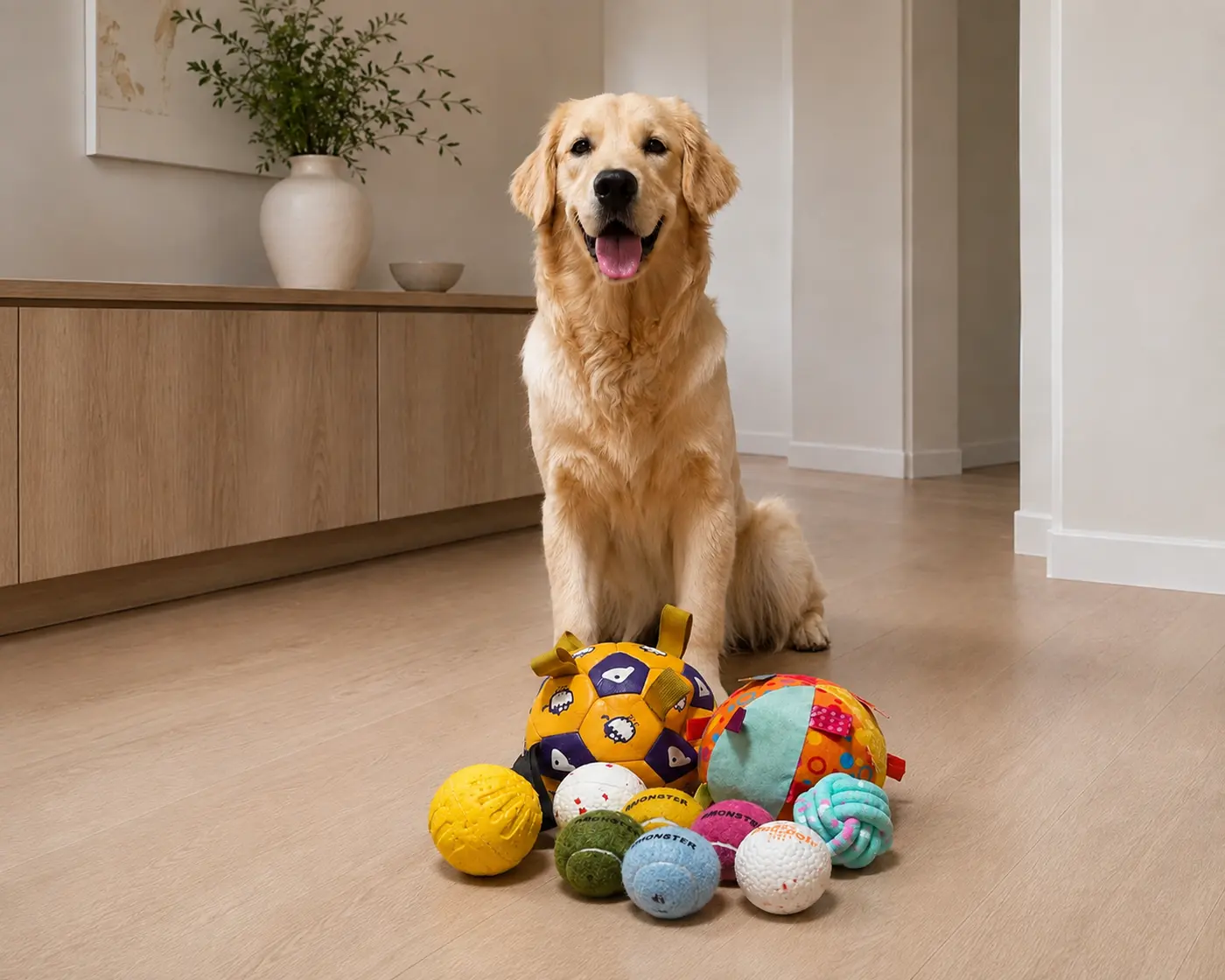
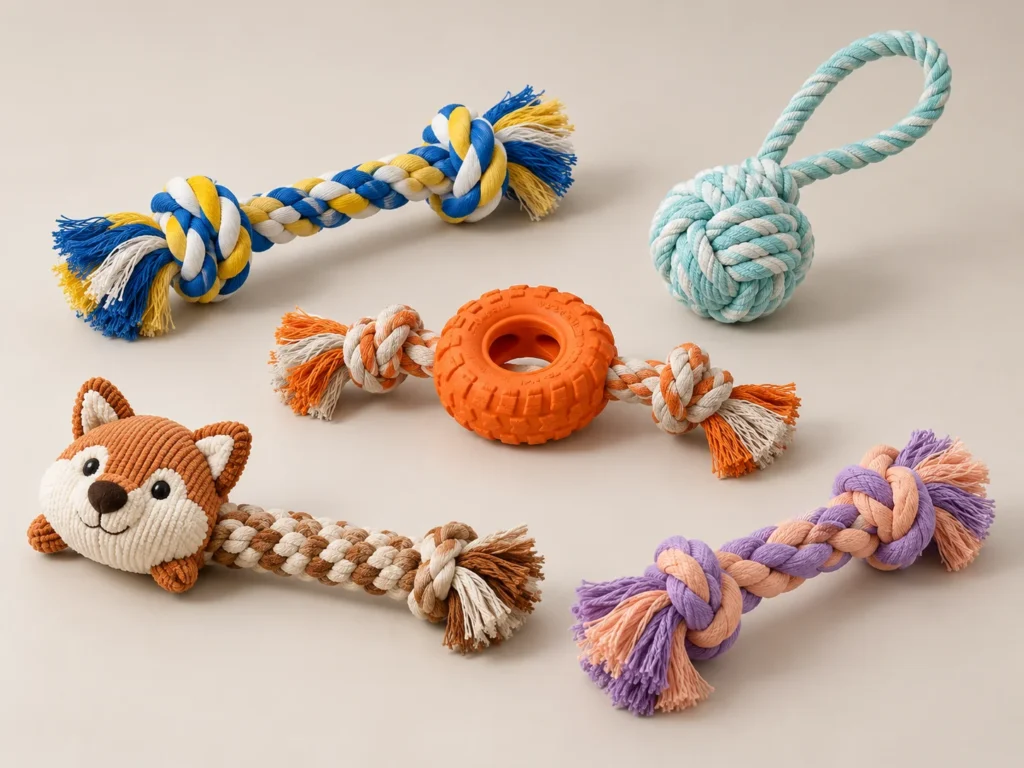
When planning a rope dog toy range, a pet brand can face dozens of appealing options: classic knotted ropes, loop handles, rope-and-ball toys, tire-shaped combinations, and plush animals with rope parts.
The hard part is not finding enough styles. It is deciding which ones deserve a place in the same product line.
For example, both a double-knot rope and a loop-handle toy can be used for tug, but they offer different ways to grip the toy. A rope-and-ball design can add fetch play. A plush-and-rope toy may appeal to customers who want a soft animal toy with an element of rope play.
For pet brands, a strong product range offers more than visual variety. Each style should have a clear use case and a reason for customers to choose it.
Before choosing, consider three questions: How do customers want to play with their dogs? What type of play is missing from your current range? And does the new design really deserve its own SKU?
Which types of play do different rope dog toys offer?
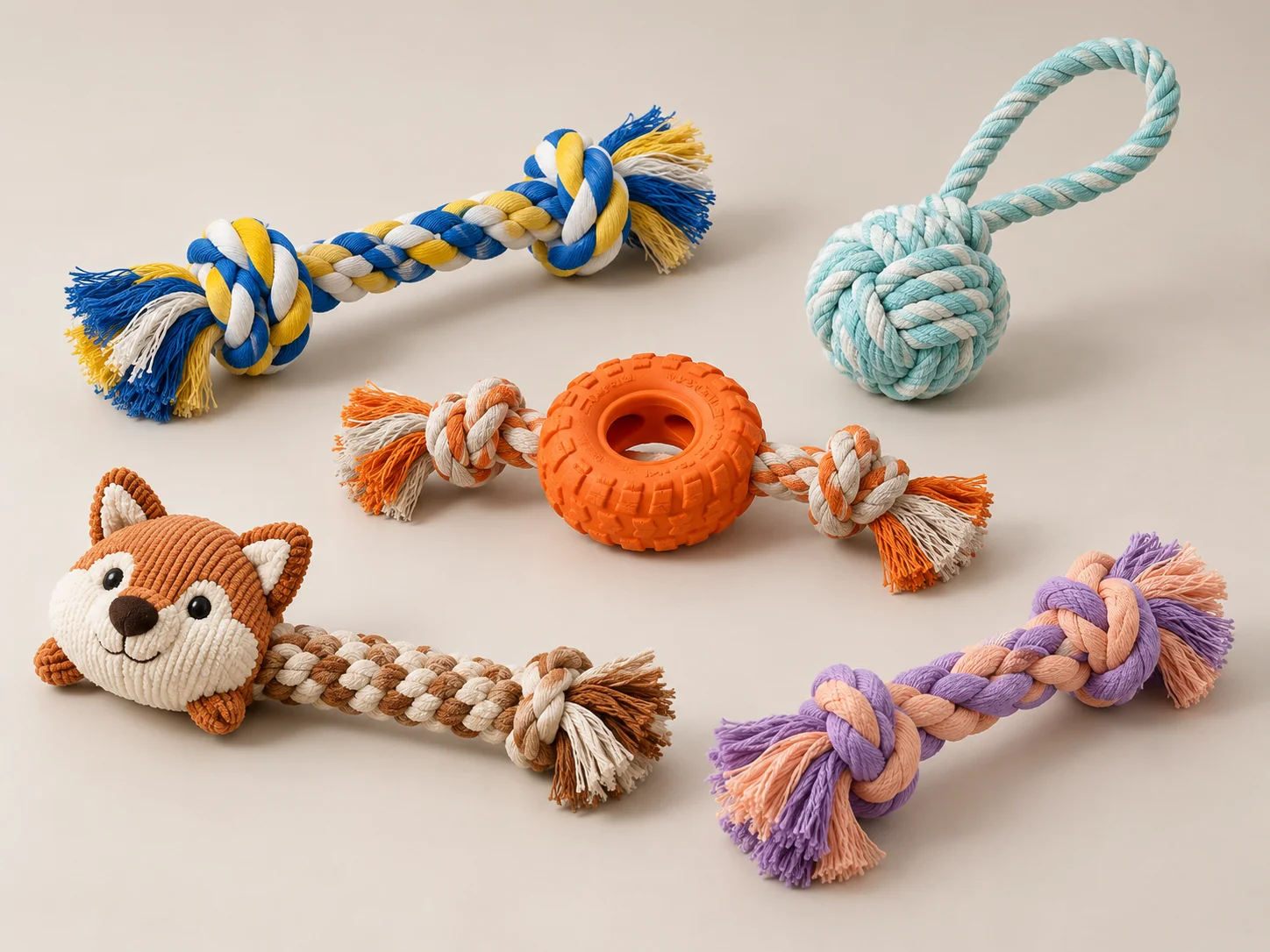
The main difference between rope dog toys is not simply the number of knots or the thickness of the rope. It is the kind of interaction the finished toy makes possible.
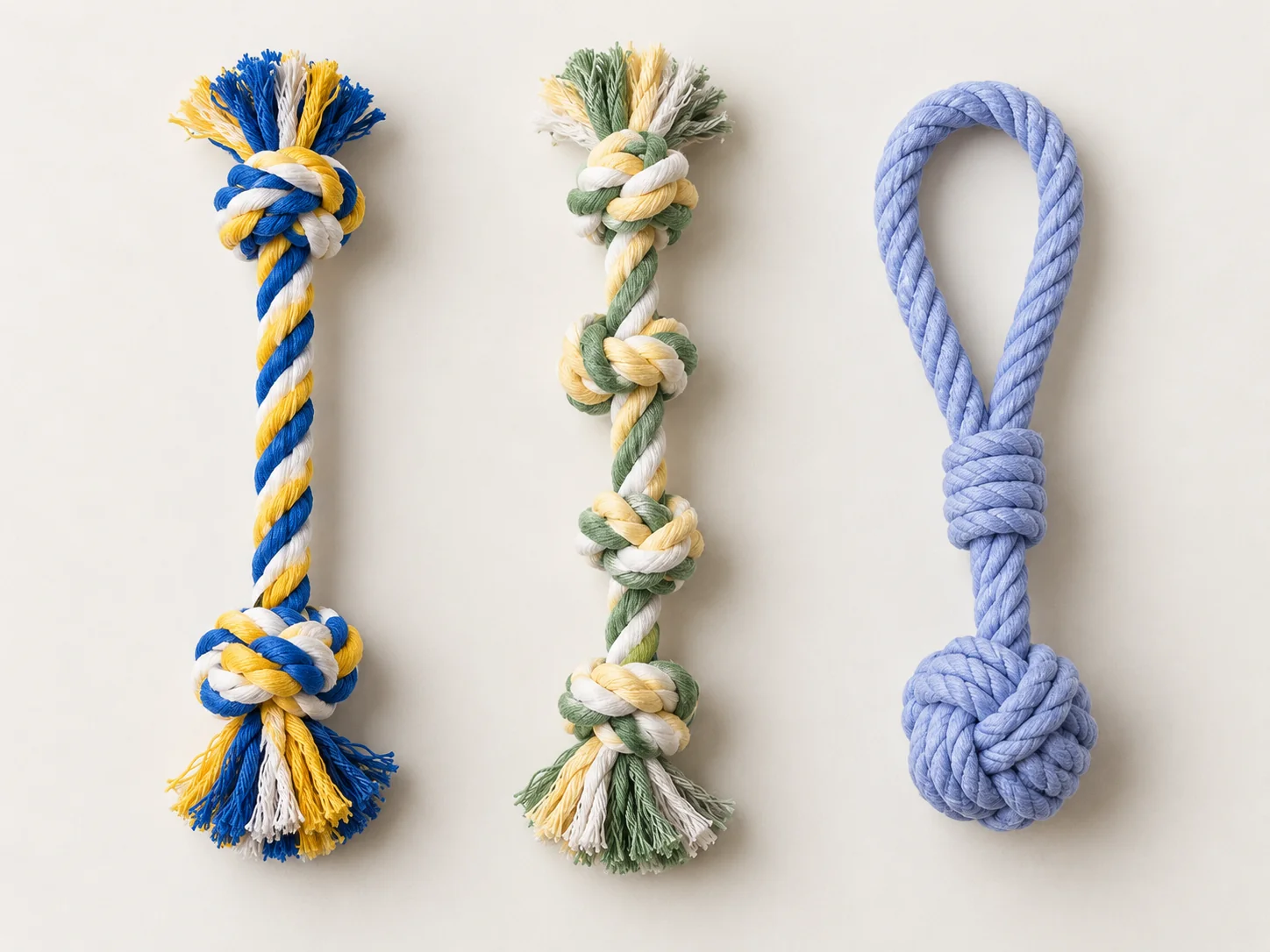
Knotted ropes and loop handles: mainly for tug
With traditional double-knot or multi-knot toys, a person and a dog can hold different points along the rope and around the knots during an interactive tug game.
These designs are fairly straightforward. Brands can develop different styles through rope length, knot placement and braiding.
A loop handle creates a more distinct place for the person’s hand.
For example, someone can hold the loop while the dog grips the knot or rope ball at the other end.
Both designs suit interactive play between a person and a dog, but a loop handle is not automatically better than a double-knot rope.
For a range centred on traditional tug play, a simple knotted rope may be enough. A loop-handle style is worth considering when a defined handle is part of the intended design.
The most useful comparison is not which toy has more knots, but whether the grip points, distance between them and overall size suit the intended use.
Rope-and-ball toys: bringing tug and fetch together
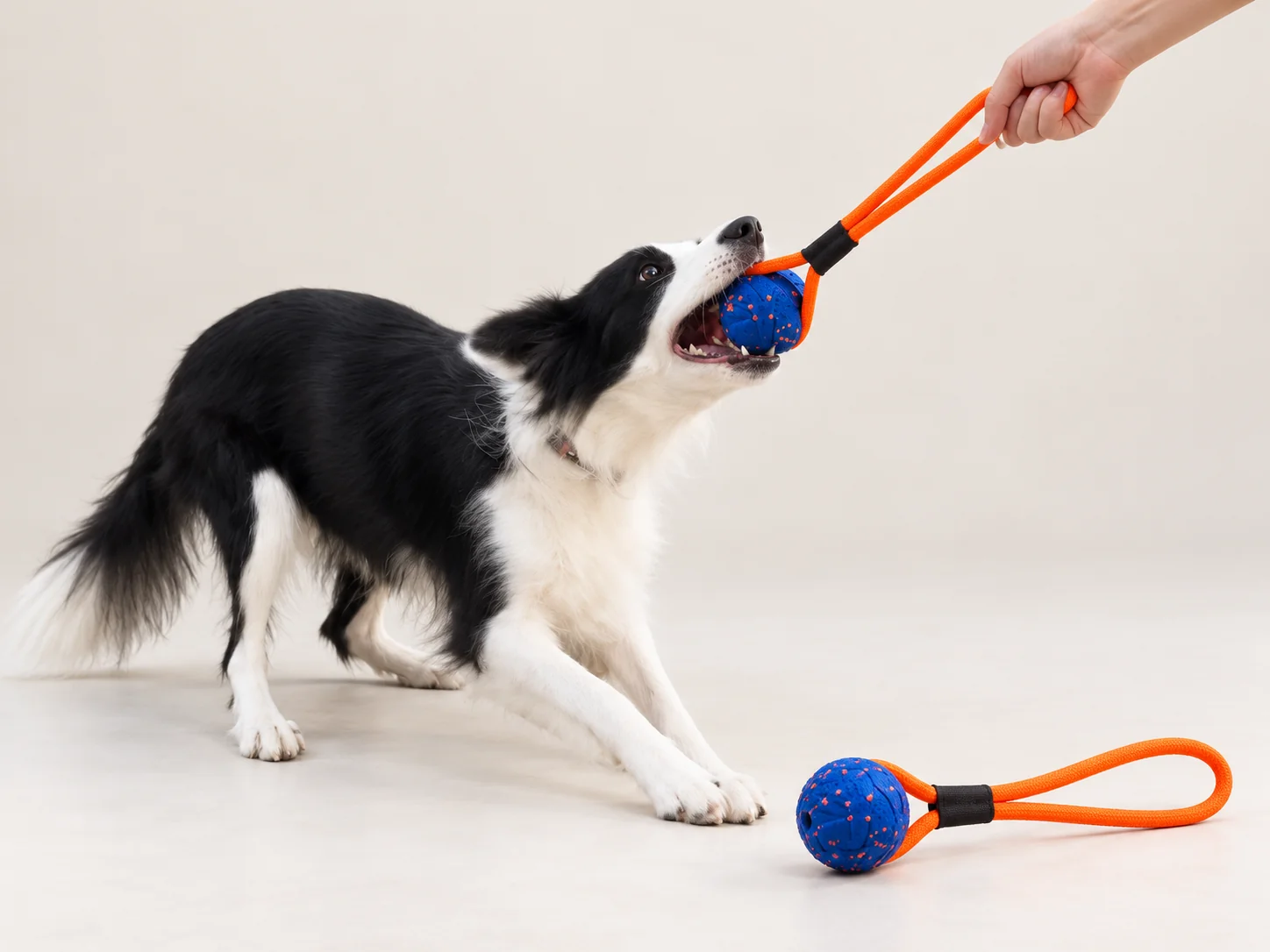
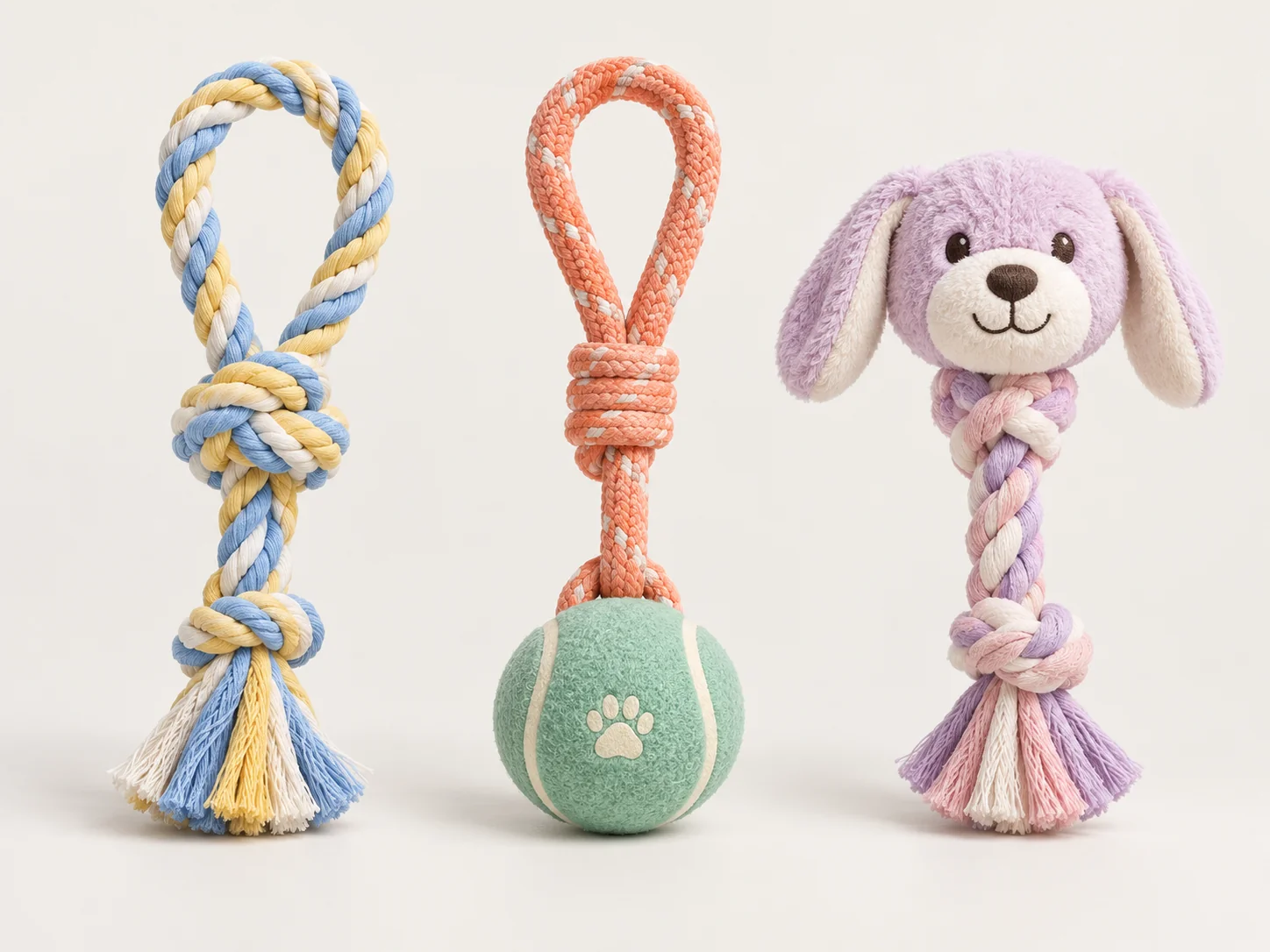
Some dogs enjoy chasing and retrieving balls. Combining a ball with a rope can give a toy both fetch and tug possibilities.
For example, a toy with a ball at one end and a loop handle at the other allows a person to hold the loop to throw it while the dog mainly retrieves the ball.
The rope can also be part of interactive tug play when the finished design is suitable for that use.
For a brand, the value of adding a ball is not simply making the toy look more elaborate. It gives the product a ball-shaped part to grip that an ordinary knotted rope does not have.
But not all balls behave the same way.
Ball size, weight, material, bounce and the way it connects to the rope can all affect whether the product suits the fetch play a brand intends to promote.
If fetch is a leading selling point, the ball and the performance of the complete toy should be central to sample review—not just the rope colours or the ball’s appearance.
Plush-and-rope toys: adding soft play and character designs
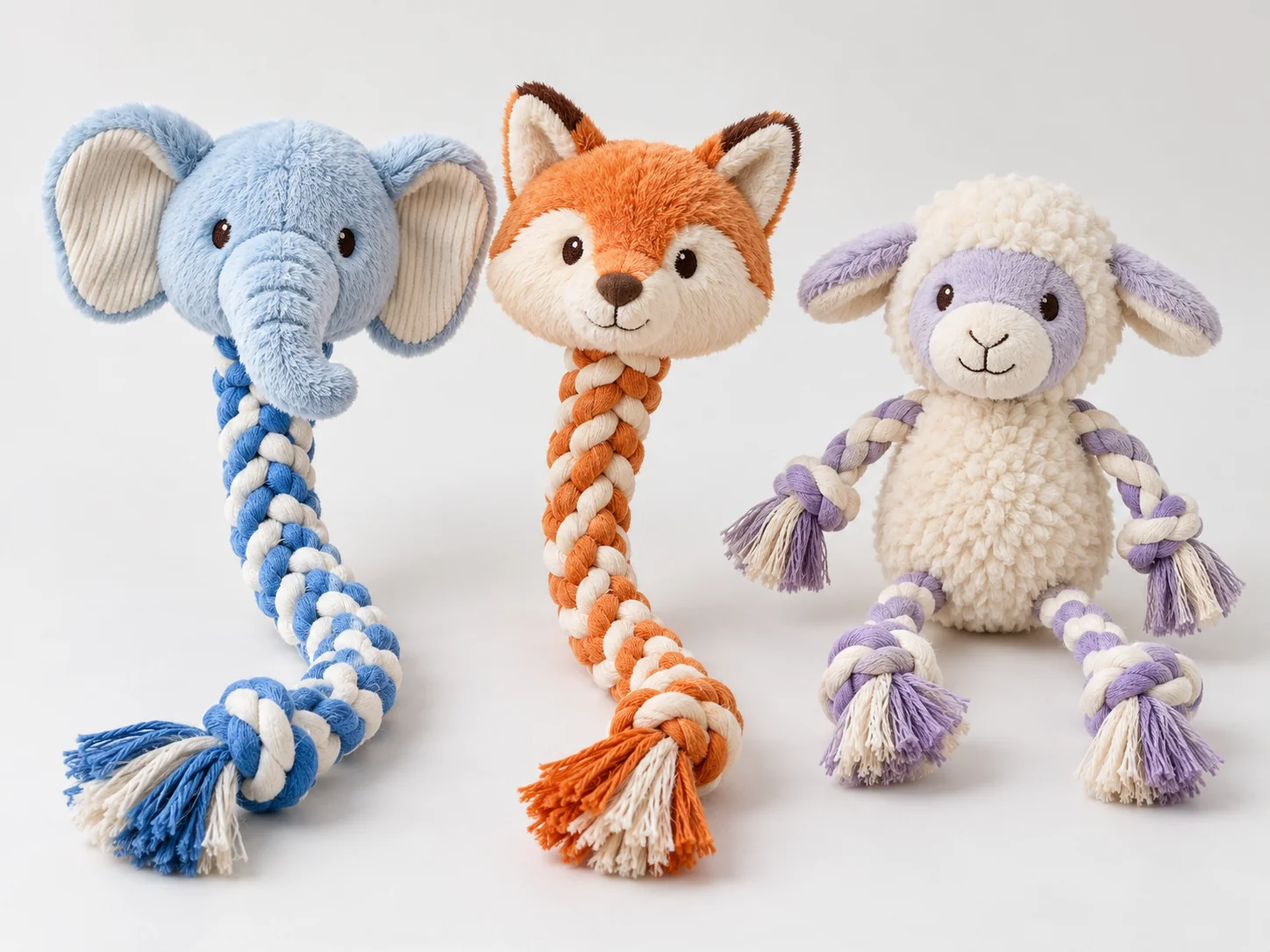
Plush animals combined with rope offer a different product position from traditional knotted ropes.
A soft animal head joined to a braided rope, for example, can combine a character design, a soft feel and a section of rope that can be held.
Customers may choose the toy for its animal character and soft fabric. Dogs may carry it, shake it, chew it gently or play with a person, depending on the design.
For pet brands, this direction is well suited to animal-themed or seasonal ranges, or collections that work alongside plush dog toys.
Not every plush toy with a rope detail, however, is suitable for tugging.
If the rope is only decorative and the main play experience comes from the plush body, the product is closer to a plush dog toy.
If a brand wants to offer tug play, it needs to confirm that the rope actually serves that purpose and that its connection to the plush body is suitable for the intended use.
A soft feel is a product characteristic. It does not, by itself, mean the toy is suitable for unsupervised play, relieves anxiety or can withstand forceful tugging.
Rope with soft rings: a different grip shape and surface feel
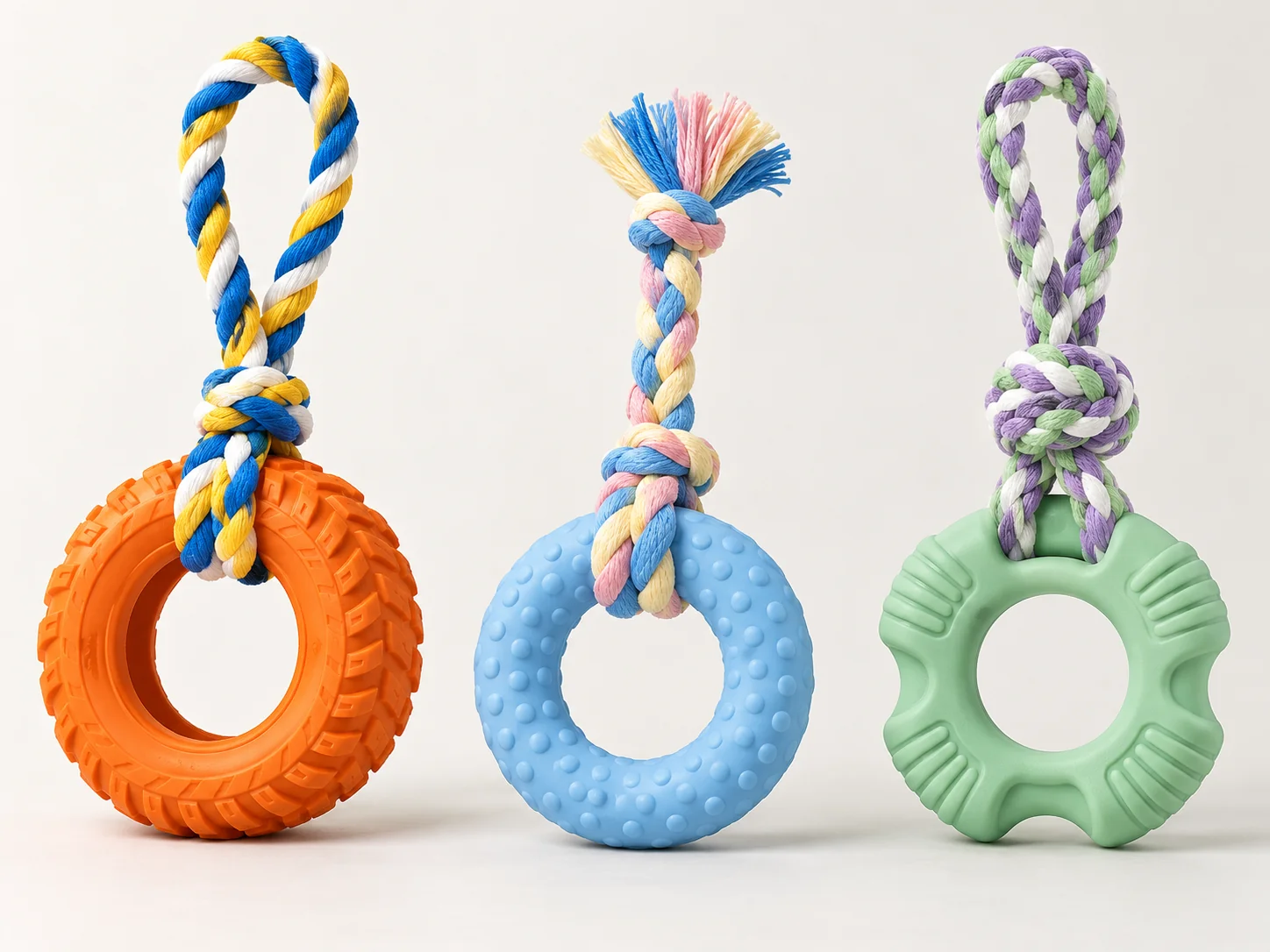
Combining rope with a tire-shaped ring, a textured ring or another soft moulded part creates another product direction.
One part of the toy is rope; the other has a more defined shape and a different surface texture.
Compared with an all-rope toy, it gives a dog another shape to grip and can create different holding points during tug play.
This construction is worth considering when a brand wants to add mixed-material designs alongside its traditional knotted ropes.
Adding a soft part does not, however, automatically make a toy tougher, softer in actual use or suitable for every dog.
The specific material, dimensions and firmness of the moulded part, the rope connection and the performance of the finished toy all depend on the chosen design.
Shaped braided toys: standing out through theme and design
Rope can also be braided into carrots, animals and other themed shapes.
Their main appeal is often their recognisable shape rather than a traditional two-ended tug structure.
For brands already offering basic knotted ropes and rope-and-ball styles, shaped braids can add more variety to themed collections.
Vegetable designs, for example, can sit alongside other toys with the same theme, while animal shapes offer different characters.
An appealing shape does not necessarily add a new form of play.
If a braided toy has no clear grip areas at opposite ends, it should not be marketed as a dedicated tug toy simply because it is made from rope.
Which rope dog toy styles are worth adding to a product range?
The point of this comparison is not to declare one type of toy the best. It is to understand why each could deserve a place in a collection.
| Toy style | Customer experience to highlight | Value in a brand’s range | What matters when choosing |
|---|---|---|---|
| Double-knot and multi-knot ropes | Interactive tug and carrying | A classic core style with different sizes and braids | Rope diameter, length, knot placement and grip space |
| Loop-handle ropes | Interactive tug with a defined hand grip | A different grip layout from a standard knotted rope | Loop opening, usable rope length and shape of the other end |
| Rope-and-ball toys | Fetch, chasing, carrying a ball and some tug play | Adds fetch possibilities to the range | Ball size, weight, actual fetch performance and connection |
| Rope with a soft ring or tire | Different textures, grips and interaction | Mixed materials and a different main body shape | Material, dimensions and connection of the moulded part |
| Plush animals with rope | Soft feel, character design, carrying and some interactive play | Soft-play and themed range options | Role of plush parts, rope connection and intended play |
| Shaped braided ropes | Themed shapes, carrying and some interaction | Visual identity and themed variations | Whether the braided shape supports the intended use |
For example, adding another double-knot rope in a different colour to an existing double-knot collection mainly expands its colour choices.
Adding a rope-and-ball design, by contrast, may introduce fetch play into that range.
Adding a plush-and-rope toy can provide a different feel and a character-led look.
For a pet brand, a new SKU is most worthwhile when customers can understand why they might choose it—not simply because it comes in another colour or shape.
That does not mean every style needs a completely different use. Multiple sizes, colourways or themes of the same design can also make a well-defined collection.
The first step is to decide whether you are expanding a style, adding a colourway or introducing a different product direction.
Explore Rope & Tug Toys and the next steps
Once the main play direction is clear, explore specific designs before deciding which products to keep or develop further.
Explore Rope & Tug Toy Options and Next Steps
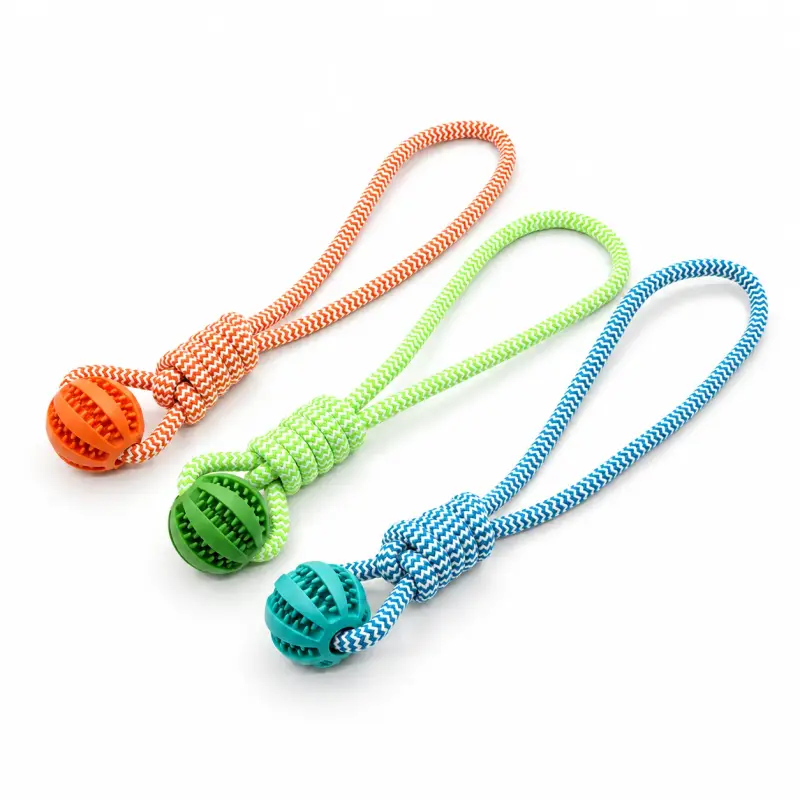
Rope & Tug Toys
Browse knotted ropes, loop handles, rope-and-ball toys and mixed-material styles to compare specific designs.
View Rope & Tug Toys →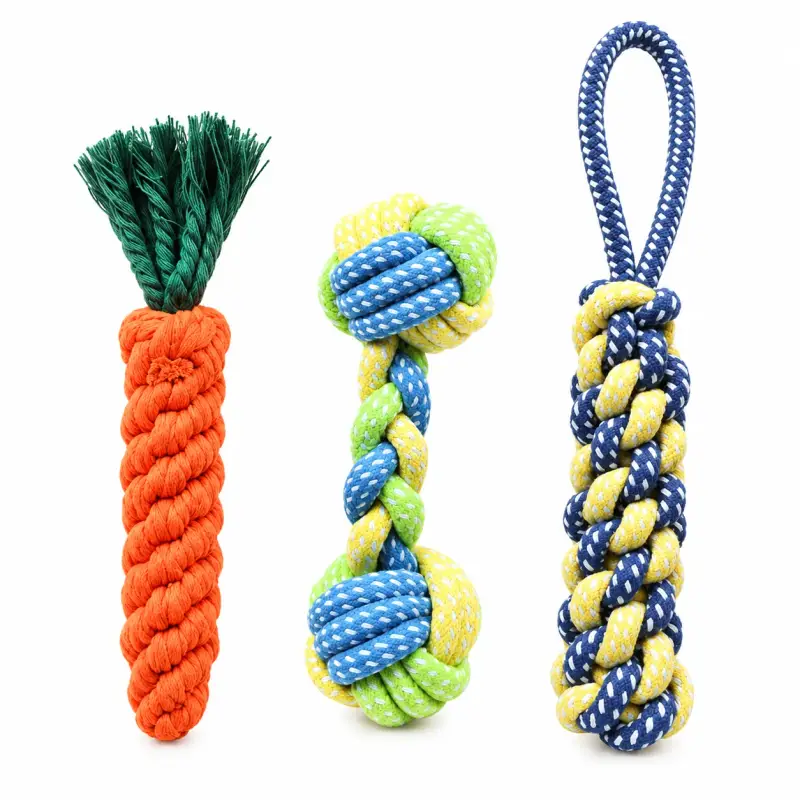
Dog Toys
Explore other dog toys, including plush, chew and fetch styles, to see how different play types fit into a collection.
Explore Dog Toys →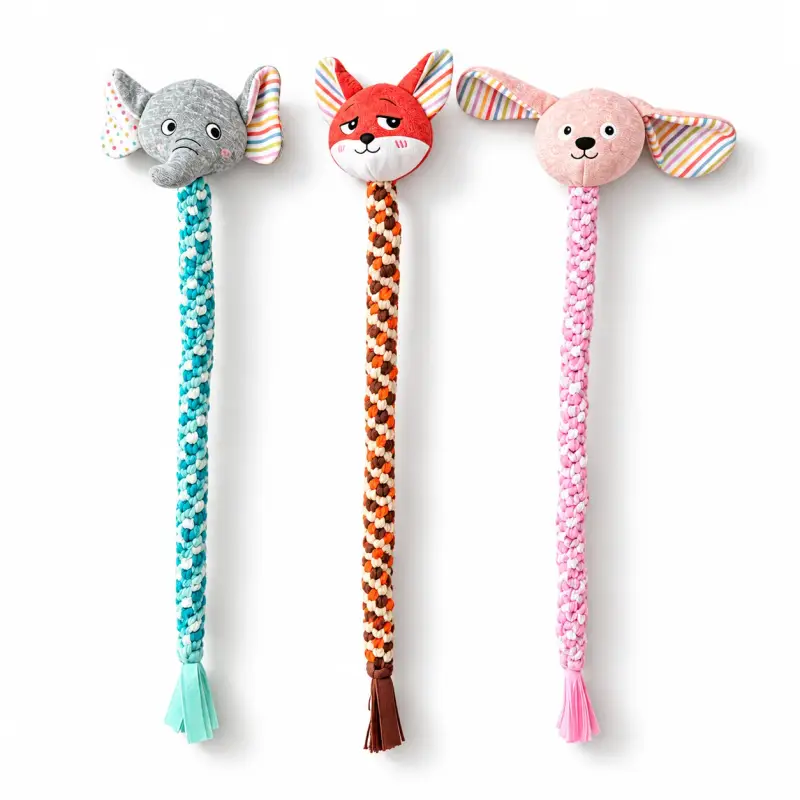
Customization
After choosing a design direction, discuss materials, sizes, colours, branding, samples and packaging.
View Customization →What if your brand wants to develop just three rope dog toys?
Three toys do not have to use three different materials, and they do not need to be the most elaborate designs available.
A better starting point is to decide which needs those three products should serve.
Option A: Cover different ways to play
If a brand wants a rope dog toy range with several play scenarios, it can compare three directions:
First: A core tug toy.
Choose a double-knot rope or a loop-handle toy.
This gives the collection a straightforward tug option with an easily understood purpose.
Second: A fetch-and-tug combination.
Choose a rope-and-ball toy.
Compared with a basic knotted rope, it has a ball-shaped part and can support fetch and tug play when the design is suitable.
Third: Soft play and a character design.
Choose a plush animal toy with a functional rope section.
This adds a softer feel and animal character to a collection otherwise built around all-rope toys.
The value of this combination is that each toy has a relatively clear reason to buy, rather than three items making the same tug-play claim.
Option B: Focus on tug toys
A brand specialising in tug toys does not necessarily need a plush animal design.
It can compare:
- Classic double-knot or multi-knot ropes;
- Ropes with loop handles;
- Ropes combined with a ball or moulded ring.
All three remain focused on tug, but offer different hand grips, areas for the dog to hold and overall constructions.
This option suits a brand that wants more choice within a single main play category.
Option C: Build a themed or gift-ready range
If a brand puts more emphasis on theme and appearance, it might combine animal-head rope toys, vegetable-shaped braided toys and classic ropes in coordinated colours.
The distinction here is the theme and visual design, not a claim that every toy adds an entirely new function.
Mixed materials, unusual shapes and different sizes may also require different production or packaging arrangements.
If the toys will be sold as a set, the brand should confirm the pack size, what is included and the play differences customers will be able to recognise.
How should the three options be compared?
| Range objective | Styles to compare first | No need to add just for variety |
|---|---|---|
| Cover different play types | Core rope + rope-and-ball + plush-and-rope | Several standard ropes with nearly identical uses |
| Focus on interactive tug | Double-knot + loop handle + combination tug toy | Plush styles chosen mainly for appearance |
| Emphasise themes and characters | Animal-head rope + shaped braid + coordinated classic ropes | Other products unrelated to the collection’s theme |
These are options for planning a product range, not a fixed assortment that every brand should buy.
If a brand already has related products, the most worthwhile addition is one that offers something its current range does not—not another toy filling exactly the same role.
Does the toy actually support the feature you want to sell?
When a brand starts selecting toys, it often already has a few selling points in mind.
For example:
- Made for interactive tug games;
- Can be used for fetch;
- Has a soft animal character;
- Combines rope with another surface texture.
These descriptions can help customers understand a toy, but they must match the finished product.
If tug is the main selling point, more knots are not always better
For tug toys, where the person and dog can hold the toy matters more than the number of knots alone.
For example, if a loop handle takes up most of a toy’s length, the remaining grip space may not be what the design calls for.
On a double-knot toy, the finished sample can show the distance between the knots and how the rope is meant to be held.
A brand should choose a design that fits its intended interaction, rather than judging it by appearance alone.
If fetch is the selling point, the ball has to work for that play
Adding a ball to a rope does not guarantee a satisfying fetch toy.
The ball’s weight and the rope length, for example, affect throwing and retrieving. Bounce and flotation also cannot be assumed from a material name alone.
For a product marketed around fetch, the relevant features should be checked with a finished sample.
If the toy’s real strength is rope-ball tug play, there is no reason to promote unverified bouncing or floating performance just to add more selling points.
If soft play is the focus, distinguish the plush body from the tug structure
Animal heads, plush bodies and rope limbs can form different constructions.
If shoppers are mainly drawn to the soft feel and animal design, the brand should consider how the plush part is made and how the toy is intended to be used.
If tug is also a planned selling point, the brand needs to confirm whether the rope serves as a real tug component and whether the connection to the plush body suits that use.
A rope detail alone does not turn every plush combination into a heavy-duty tug toy.
If multiple textures are the selling point, confirm the materials and joins
Combining rope with a soft ring or tire-shaped part can give a toy different surfaces.
But the material of the moulded part and its connection to the rope still need to be confirmed on the chosen sample.
A photo alone cannot establish that a component is silicone, TPR or natural rubber, and it cannot prove superior durability.
A worthwhile selling point should make sense to the customer and be supported by the actual finished product.
How do different styles affect sourcing, samples and quotations?
Once a brand has chosen a product direction, sourcing comes down to making the intended construction clear—not just naming the toy.
For example, two products described as rope tug toys might be an all-rope design and a rope-and-ball combination.
Even if their overall lengths are similar, they may require different materials, numbers of components and production steps.
What matters for each toy style?
| Style to source | What to confirm on the sample | Why it affects the buying decision |
|---|---|---|
| Classic knotted rope | Rope composition, diameter, length and knot layout | Defines the construction and size options |
| Loop-handle rope | Handle size, grip space and the opposite-end design | Shapes how the finished toy is used for tug |
| Rope-and-ball toy | Ball material, size, weight, rope length and connection | Relates directly to the promoted type of interaction |
| Soft ring or tire combination | Moulded part’s material, shape, size and connection | Adds a separate component and joining requirements |
| Plush-and-rope toy | Plush body, rope placement, joining and internal construction | Determines which uses and claims the design can support |
| Themed braided toy | Overall dimensions, braid construction and shape details | Affects appearance and consistency across styles |
When comparing alternative materials or connections within a range, it helps to decide what the current comparison is meant to reveal and keep other main conditions as consistent as possible.
That makes it easier to see which design best fits the intended product.
Why do materials and construction affect the quote?
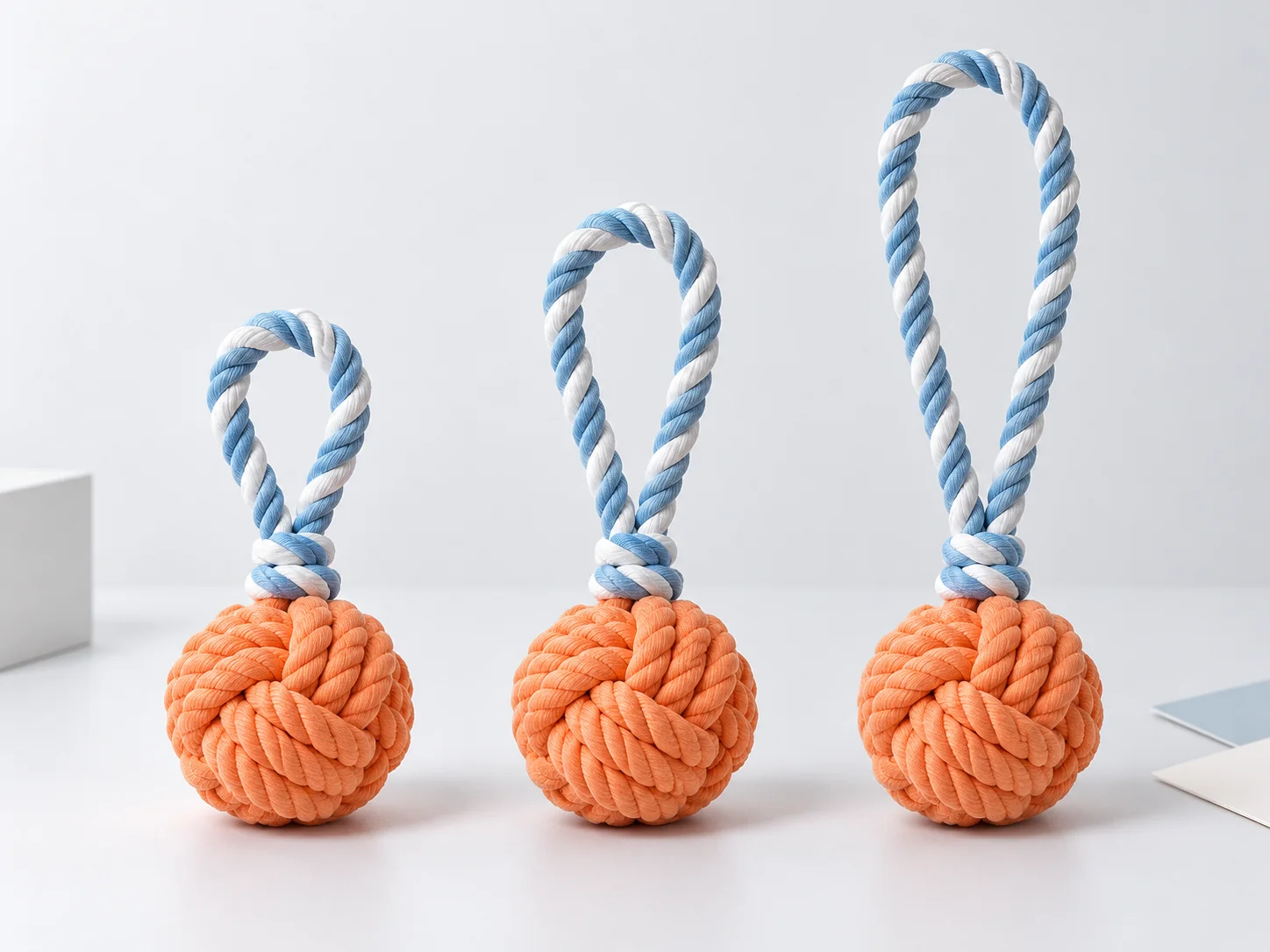
An all-rope toy and a rope-and-ball toy may use different quantities of material and have different construction requirements.
Plush-and-rope designs also involve the plush body and how it joins to the rope.
More elaborate shaped braids may require different braiding and finishing work.
That is why the size of a product in a picture cannot tell you which one should cost more or less.
For a brand developing multiple SKUs, the quotation should clearly match each style’s materials, dimensions, colours and packaging.
If a sample has already been approved and a main material, ball size or connection is later changed, the affected specifications and price may need to be reviewed.
How should you prepare your first inquiry?
If you have a reference product, start with a picture, the target dimensions, estimated order quantity and intended sales market.
If the design is still open, you can explain which play types the collection should cover—such as tug, fetch or soft play—before discussing specific styles.
Brands considering several toys together can also explain which products will be sold individually, which might form a set, and their preferred colours and retail packaging.
That gives both sides a clearer starting point for comparing real products, without requiring an elaborate technical specification for the first inquiry.
Common questions about choosing rope dog toys
Is a rope-and-ball toy a better addition than another knotted rope?
Not necessarily.
If your range lacks fetch play, a rope-and-ball design may add something meaningful.
For a brand focused on traditional tug games, a plain knotted rope or loop handle may be a better fit.
What matters is whether the new design meets a need your existing products do not cover well.
Can plush-and-rope toys be sold as tug toys?
It depends on the construction.
If the rope is a functional tug component and the complete product suits that use, tug positioning may be appropriate.
If the rope is decorative and the plush body provides the main experience, it is more accurate to describe the item as a plush dog toy.
Are rope toys with tire-shaped or soft rings tougher to chew?
You cannot tell from their shape alone.
Actual performance depends on the moulded material, dimensions, connection and finished construction.
Adding another material does not automatically make a toy more durable.
Should a new rope toy range add more colours or more designs first?
That depends on the range you already have.
If your current construction suits the market you serve, coordinated colour options may make sense.
If your collection lacks another play type, such as fetch or a different grip layout, exploring a new design may add more value.
Can different rope dog toys be sold together as a retail set?
Yes, depending on the products selected.
A classic knotted rope and a rope-and-ball toy, for example, can offer different types of interaction. Themed toys can also be grouped with related designs.
The set should have a clear purpose, with each toy’s intended use, contents and packaging confirmed—not simply a group of different colours.
Choose the right Rope & Tug Dog Toys for your brand
From knotted ropes and loop handles to rope-and-ball designs, soft rings and plush combinations, different constructions can help a pet brand build a range with different play experiences and product features.
The value lies not just in adding more styles, but in knowing who each one is for, what experience it offers and how it fits with the rest of the range.
If you are developing or sourcing Rope & Tug Dog Toys, share your reference pictures, target market, desired play types, dimensions and estimated order quantity with PETMERO.
We can discuss the product construction, materials, colourways, samples and customization requirements for your project.