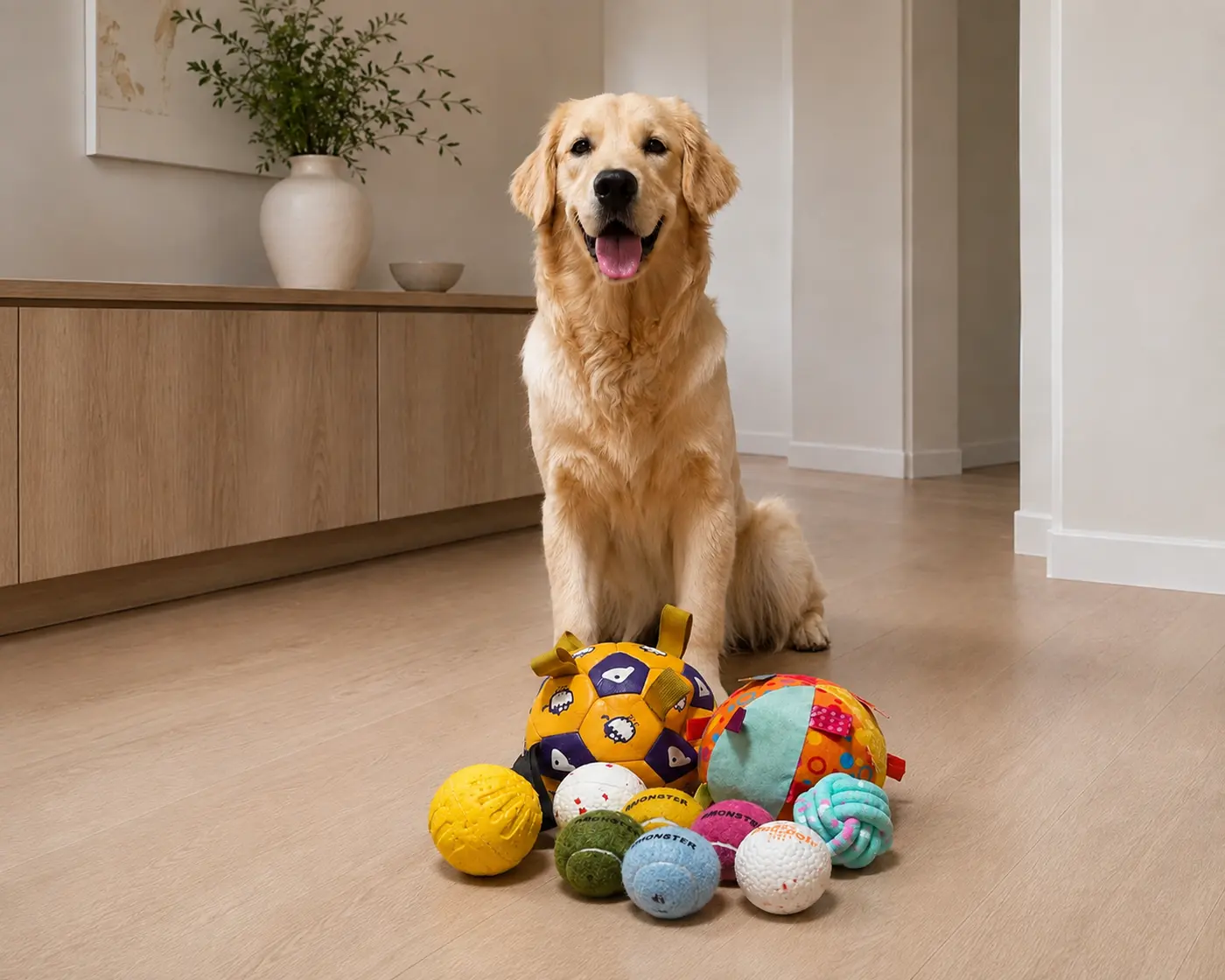
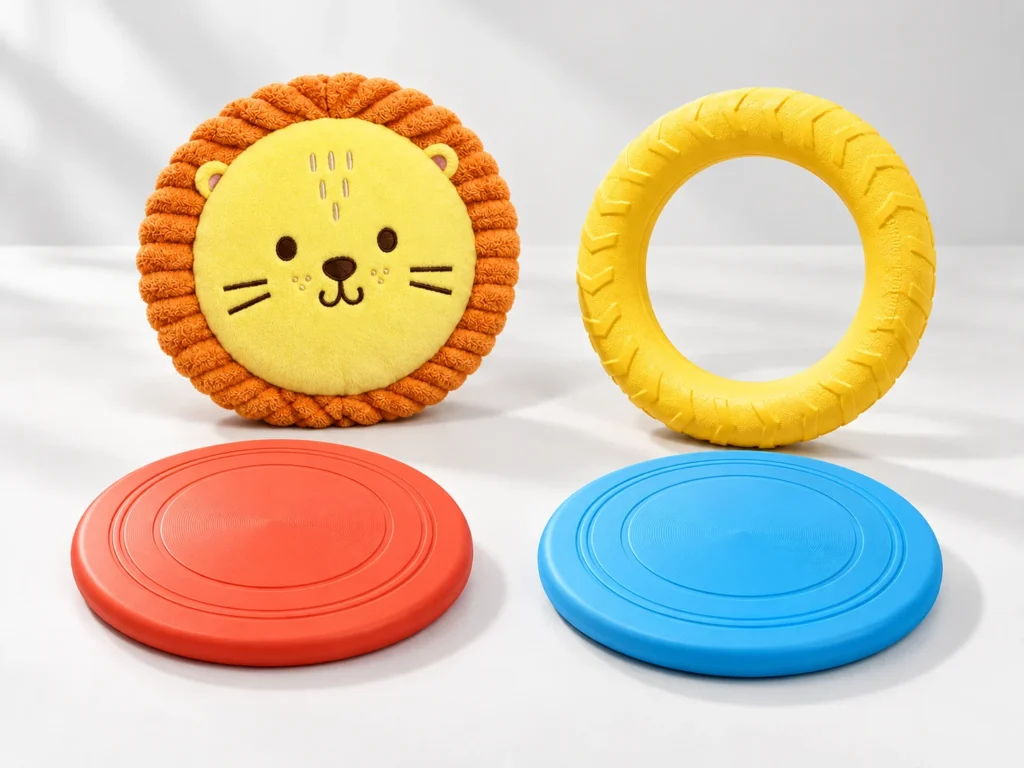
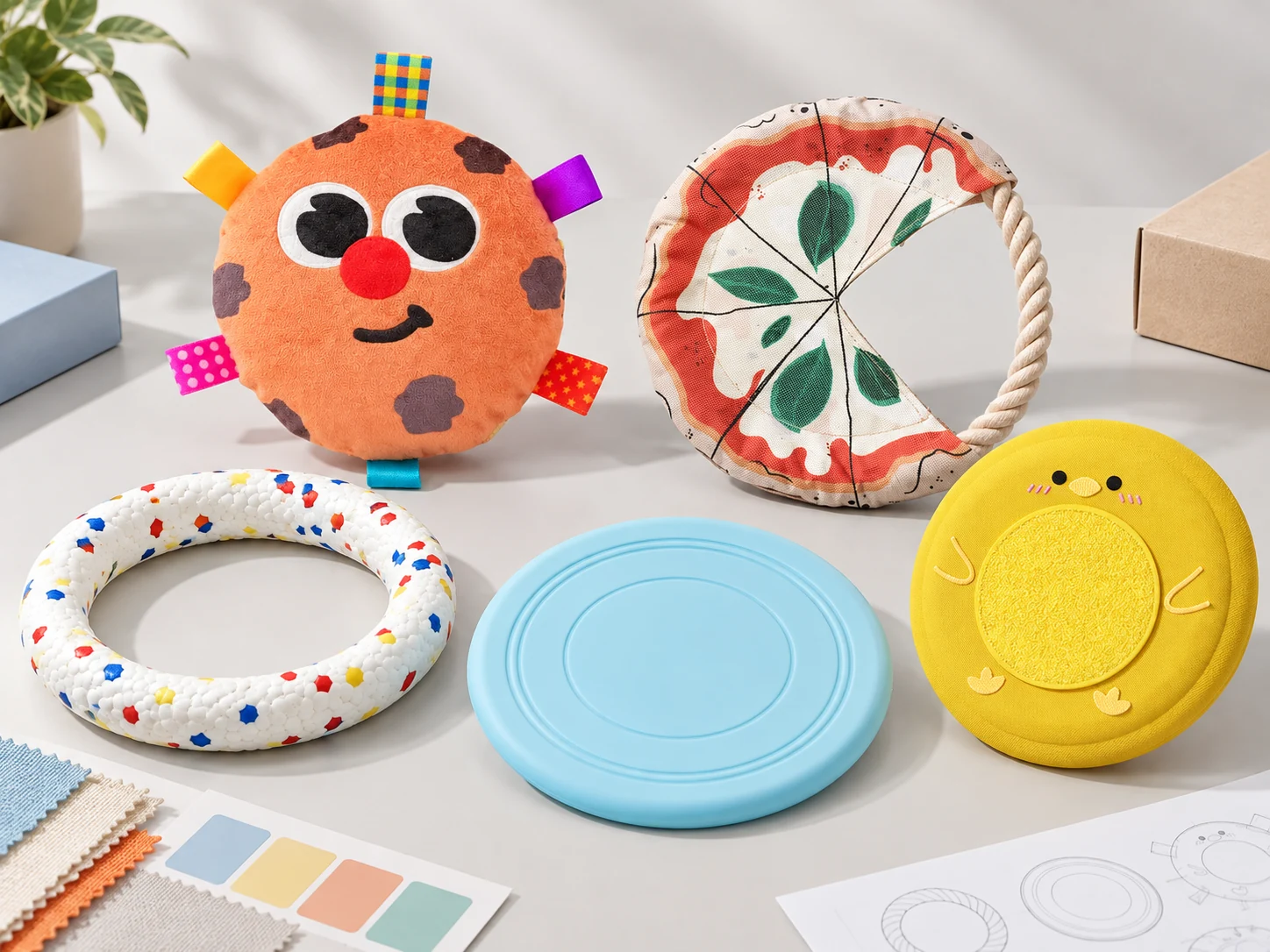
A dog frisbee collection can include far more than the familiar flat flying disc. There are plush squeaky discs, fabric-covered flyers, foam rings, flexible moulded discs, rope-handle combinations and training-focused designs.
For a pet brand, the challenge is not finding more styles. It is choosing products that give customers a meaningful reason to buy one rather than another.
Start with the play experience your range is missing. Then compare the shape, material and finished sample needed to deliver it.
The options below focus on product-line decisions, practical sample checks and what buyers need to agree with a supplier before requesting a final quotation.
What kinds of dog frisbees are worth comparing?
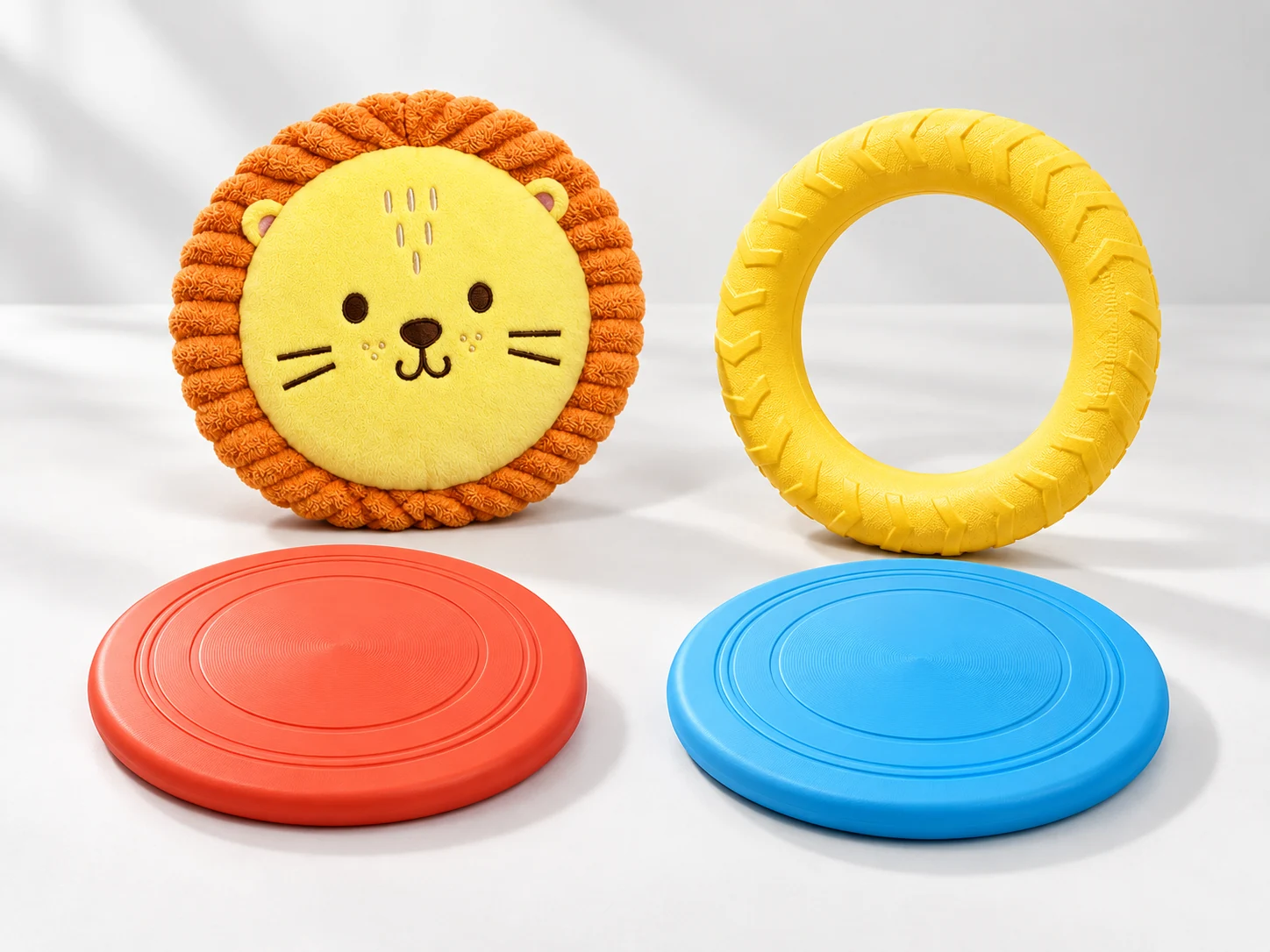
Dog frisbee and dog flying disc are broad product names. They do not tell a buyer exactly what the toy is made of or how it is intended to be used. Shape, material and play feature are three different ways to describe the same product; a fabric flyer may also be a floating toy, while a moulded disc may also be designed for training.
Plush and squeaky discs: character-led interactive toys
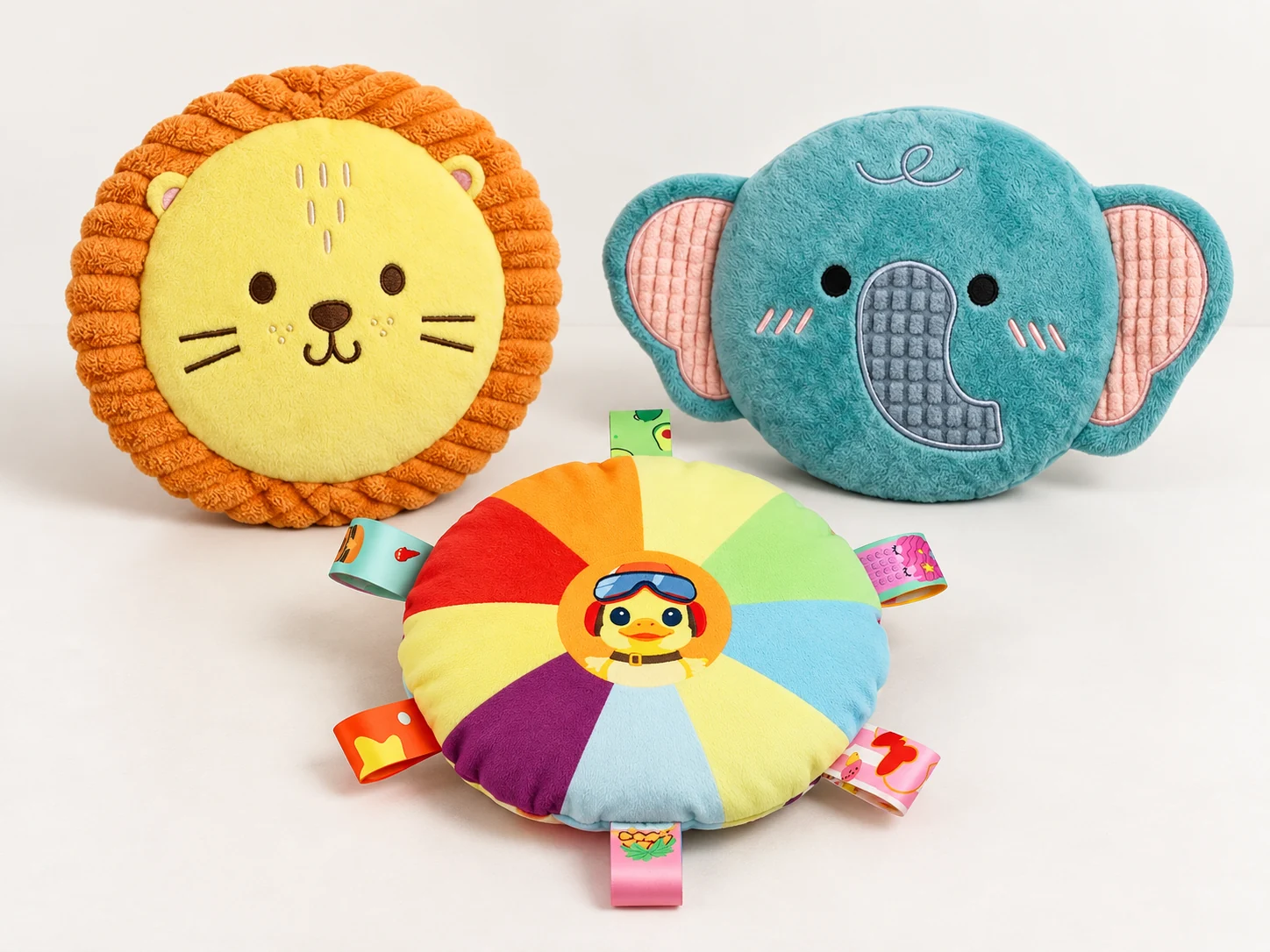
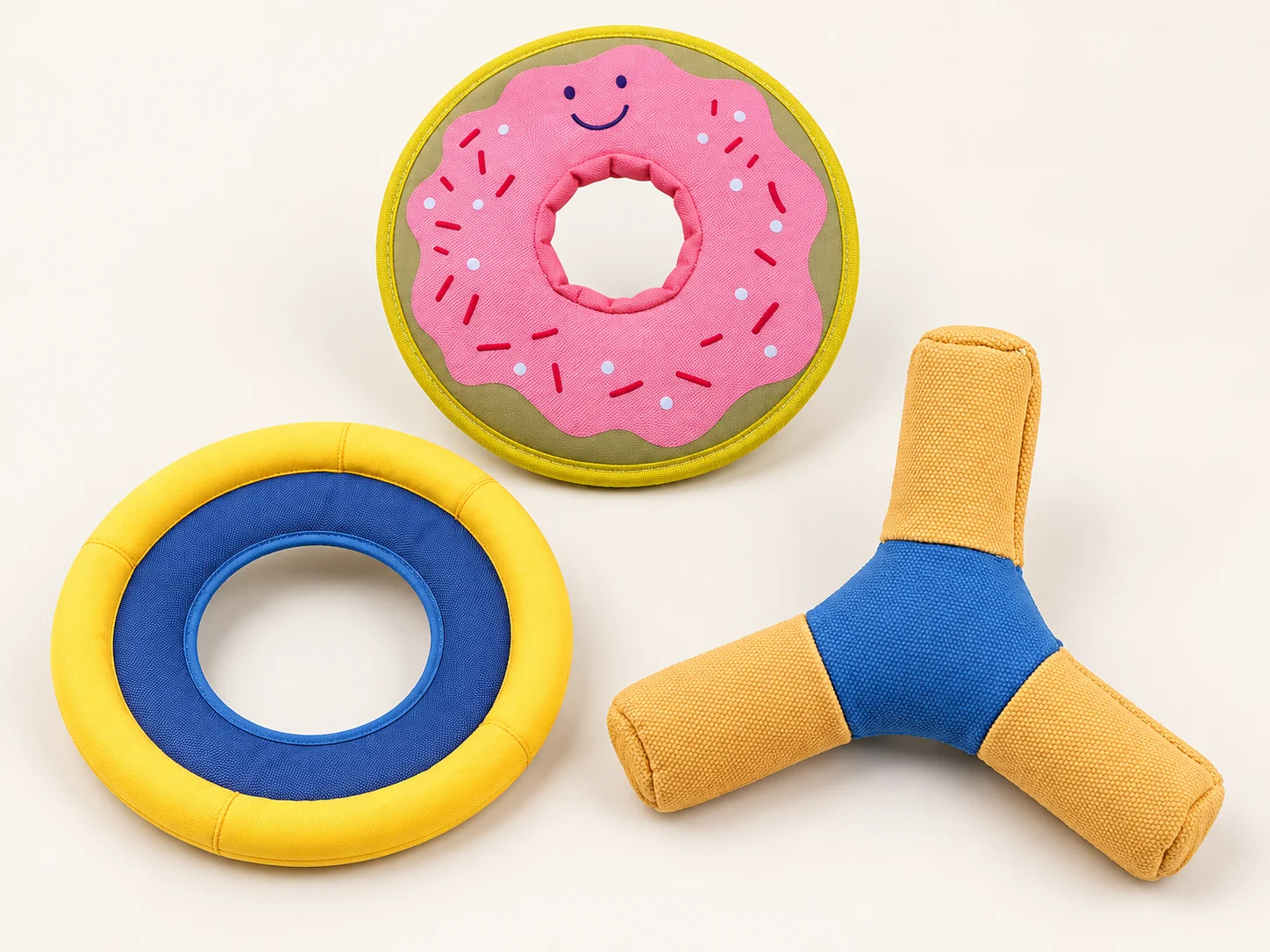
Animal faces, soft fabric and squeakers give these toys a different reason to be chosen from a conventional flying disc. They can fit a plush dog toy collection and introduce carrying, shaking or short-distance fetch to an existing character range, depending on the finished design.
The question for a brand is whether the disc shape adds a genuine play opportunity, or whether the product is mainly a round squeaky plush toy. Neither positioning is wrong, but the name and selling points should reflect the actual toy.
A plush disc that looks appealing in a product photograph should not automatically be described as a long-distance training flyer. Squeaker placement, stitched edges and the complete toy’s throw-and-catch behaviour are separate things to review.
Fabric and Oxford-cloth flyers: construction matters more than the fabric name
Not every fabric dog frisbee is plush. Some use woven fabric or Oxford cloth over a flat body or a flexible perimeter. Others combine a fabric panel with an enclosed rim that helps the toy keep its shape in flight.
For outdoor and travel-oriented ranges, this opens up options for fabric colours, printed designs and potentially compact storage. However, the rim construction determines whether a particular product can actually be folded, while the finished materials determine whether it floats or how it dries after use.
A soft textile centre and a reinforced edge should be considered together. When two fabric flyers look similar, compare the usable gripping edge, seams, overall weight and how well the full disc holds its intended shape rather than choosing from a fabric swatch alone.
Foam and flexible moulded discs or rings: different shapes, different uses
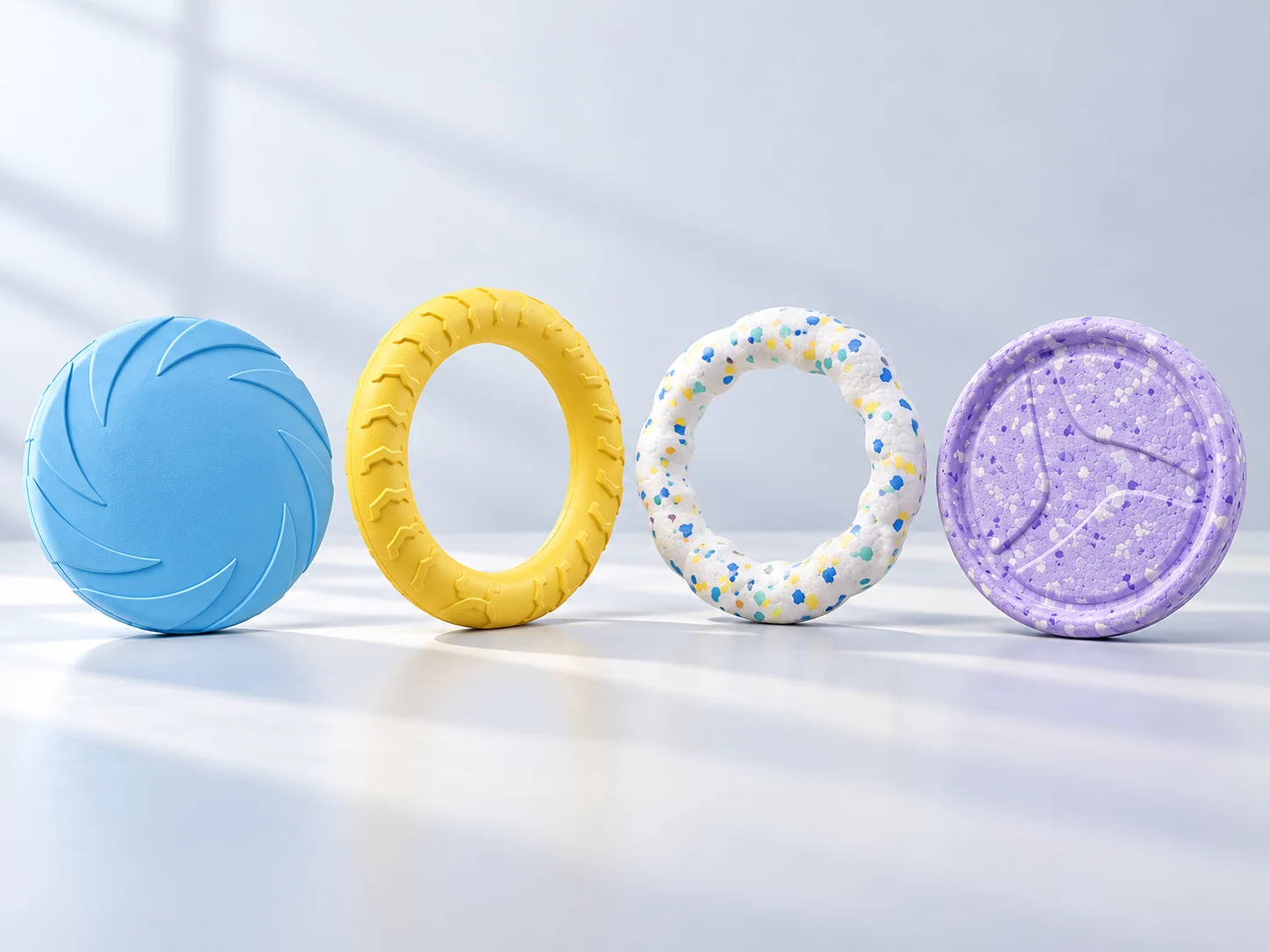
EVA foam, expanded thermoplastic polyurethane (ETPU), thermoplastic rubber (TPR), silicone and rubber are different material families. They should not be treated as interchangeable names for the same soft dog frisbee. In particular, EVA foam is not rubber, and ETPU is not simply another name for EVA.
These materials can appear in a variety of ring and disc designs. A ring gives a dog a different area to grip and may suit rolling or interactive play as well as fetching, if the finished toy supports those uses. A more conventional disc can offer a different throwing and catching experience.
Materials alone do not establish weight, firmness, bounce, floating ability or chew resistance. A buyer comparing EVA and ETPU, for example, should ask what the actual finished parts are made from and judge their intended behaviour as complete samples. The popular Chinese supply-chain nickname for ETPU should not replace the proper material description in an overseas product specification.
Training-style discs: a clearer focus on flight and catch
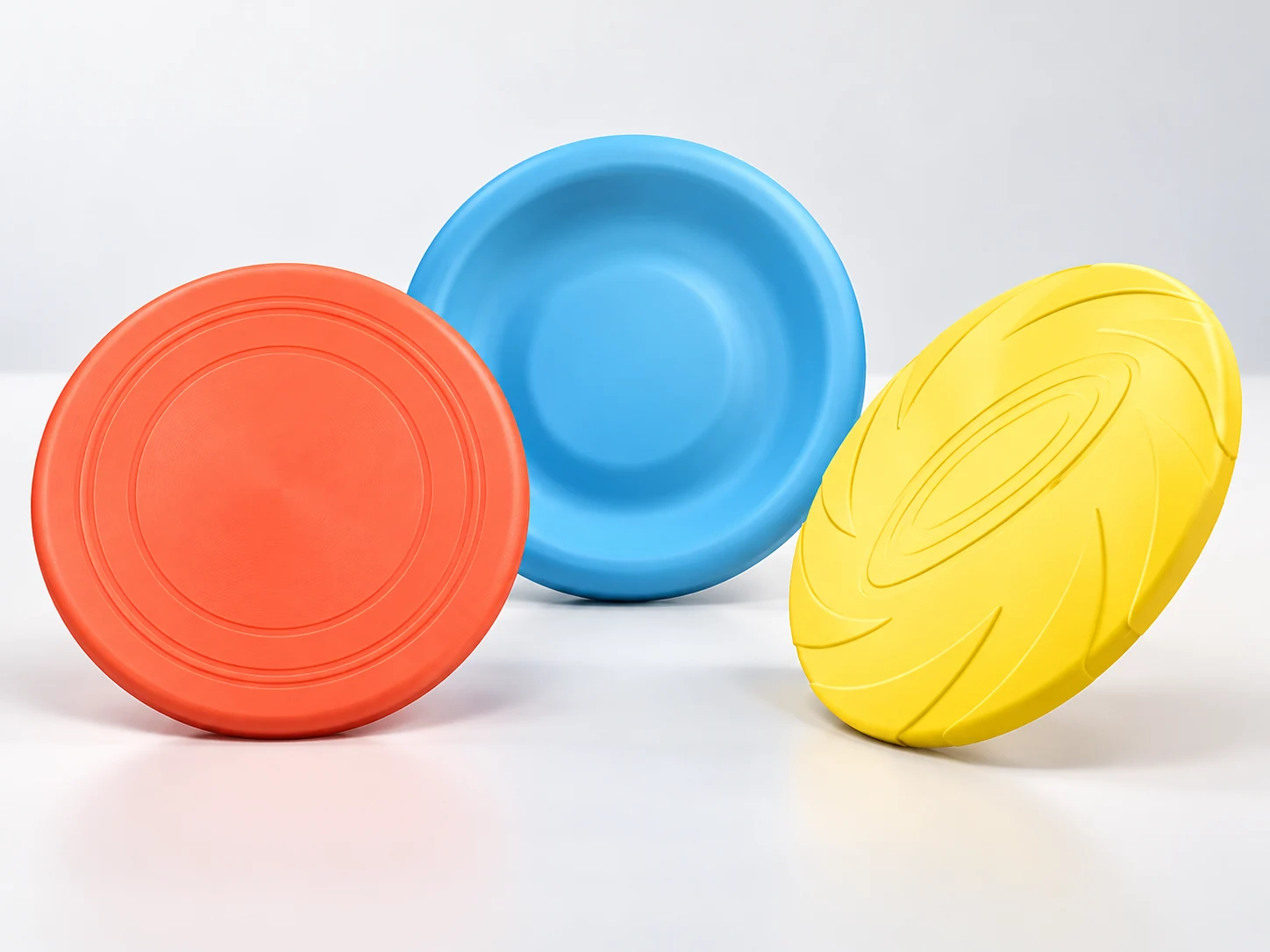
Training-focused dog flying discs are more about their throwing and catching behaviour than a novelty character or extra sound feature. Disc diameter, total weight, rim profile and material flexibility may affect how the disc feels to throw and how it behaves in the air.
Two similarly sized discs may still handle differently. A product described as a training disc should be reviewed in the context of the intended activity; the label does not by itself mean it meets any particular competition’s rules.
Specialty and mixed-material designs: add a feature, not just another SKU
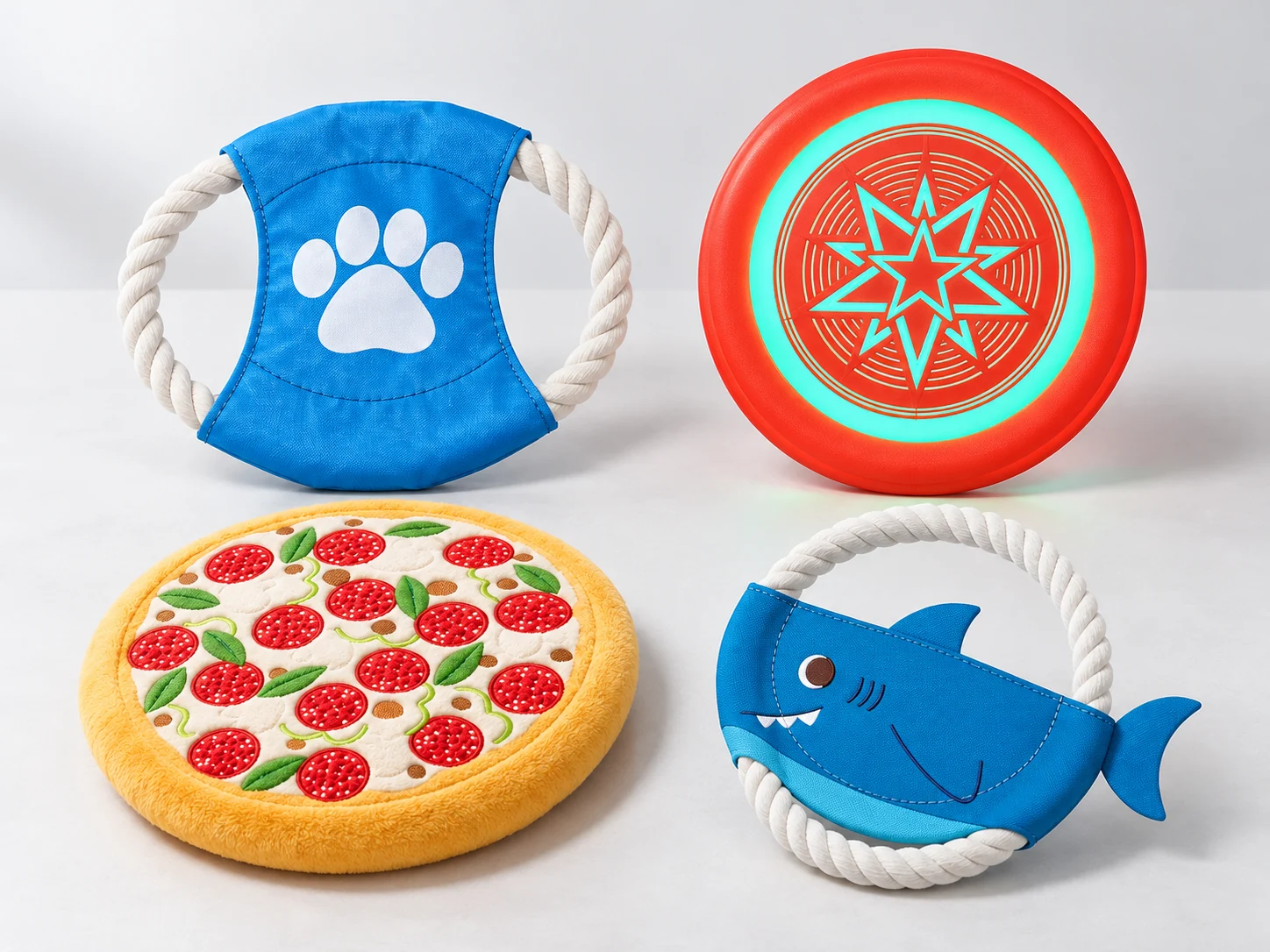
Some flyers combine rope handles with fabric panels or moulded parts. Others use shaped fabric bodies, sound features or glow-related designs to give the product a different retail identity.
These can be useful extensions when a brand already has a core flying disc. But a rope attachment does not automatically make the toy suitable for strong tugging, and a bright or fluorescent-looking surface does not prove it glows in the dark. The exact feature must be confirmed on the finished product.
Which option adds the most value to your product range?
The right starting point is not which material sounds more advanced. It is the gap in your current range and the customer experience the new toy is supposed to deliver.
| Product direction | Customer reason to choose it | Value to a pet brand | What needs proof |
|---|---|---|---|
| Plush squeaky disc | Character styling, soft feel and sound interaction | Connects plush and fetch-related collections | Squeaker, seams and real throw-and-catch use |
| Fabric / Oxford flyer | Soft textile feel, colour or graphic options, and outdoor play | A textile-based option distinct from a moulded disc | Edge construction, flight, care and any storage or float claim |
| EVA / ETPU foam designs | Specific foam feel and chosen ring or disc form | Different shapes and potential use occasions | Exact material, finished weight, grip and use performance |
| TPR / silicone / rubber discs | Flexible moulded construction and particular grip or flight feel | Another construction route for a functional range | Actual formulation, rim, flexibility and complete-toy behaviour |
| Training-focused discs | Throwing, flight and catching as the central experience | A clearer training-oriented product position | Diameter, weight, rim and flight; any specific event claim |
| Rope / sound / glow variants | An identifiable extra play feature | Extends a range only when the feature is meaningful | Connection, sound or glow performance, as applicable |
A new SKU is easier to justify when buyers can explain what it adds beyond another colour. The same design in several colours can still be a valid collection, but that is a colour extension rather than a new play direction.
Explore dog fetch toy options and next steps
If you already know which play experience is missing from your line, compare the relevant products before discussing samples and custom details.
Fetch Toys
Explore dog flying discs, rings and other fetch toys to shortlist product styles.
View Fetch Toys →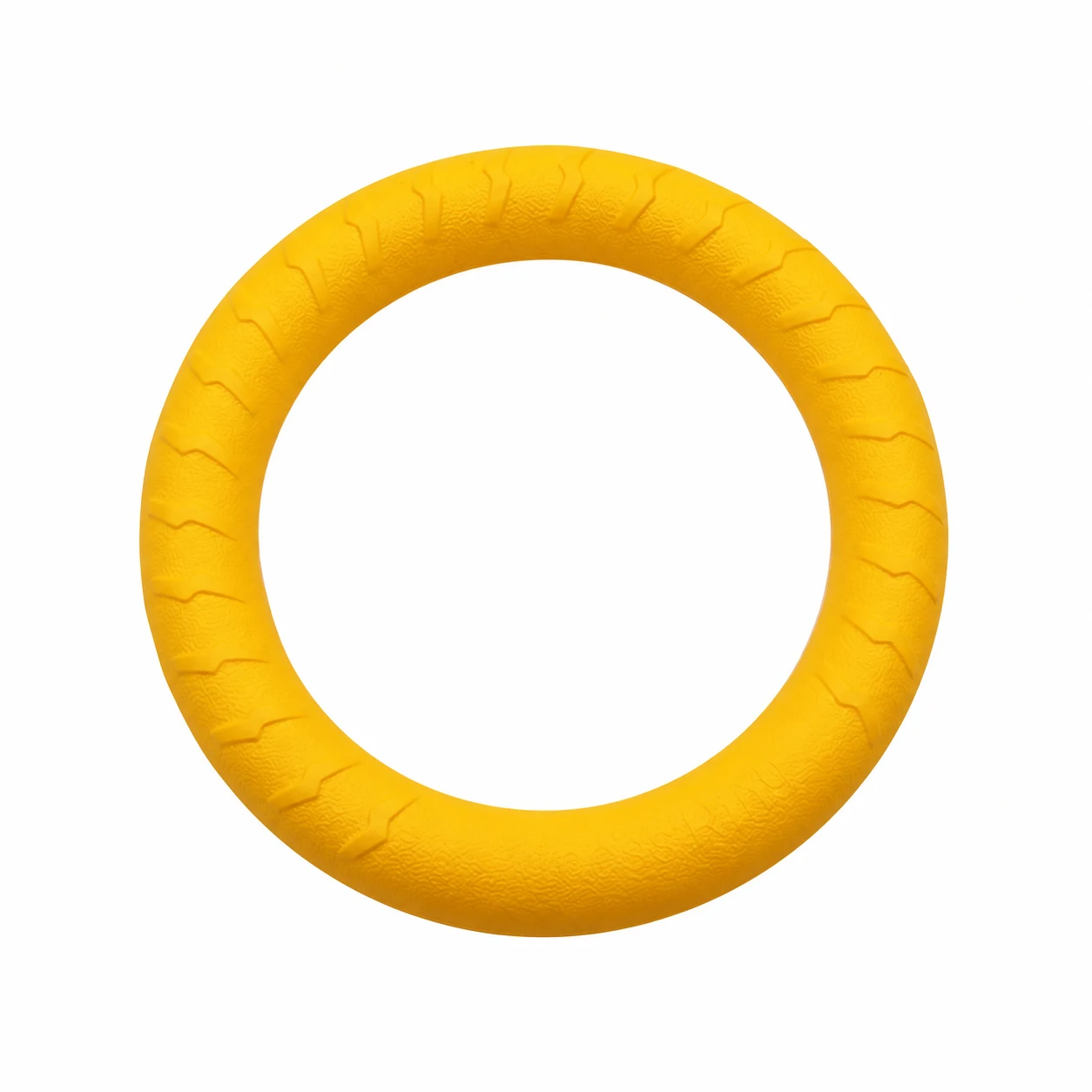
Dog Toys
See how fetch fits alongside plush, rope and chew toy options in a wider collection.
Explore Dog Toys →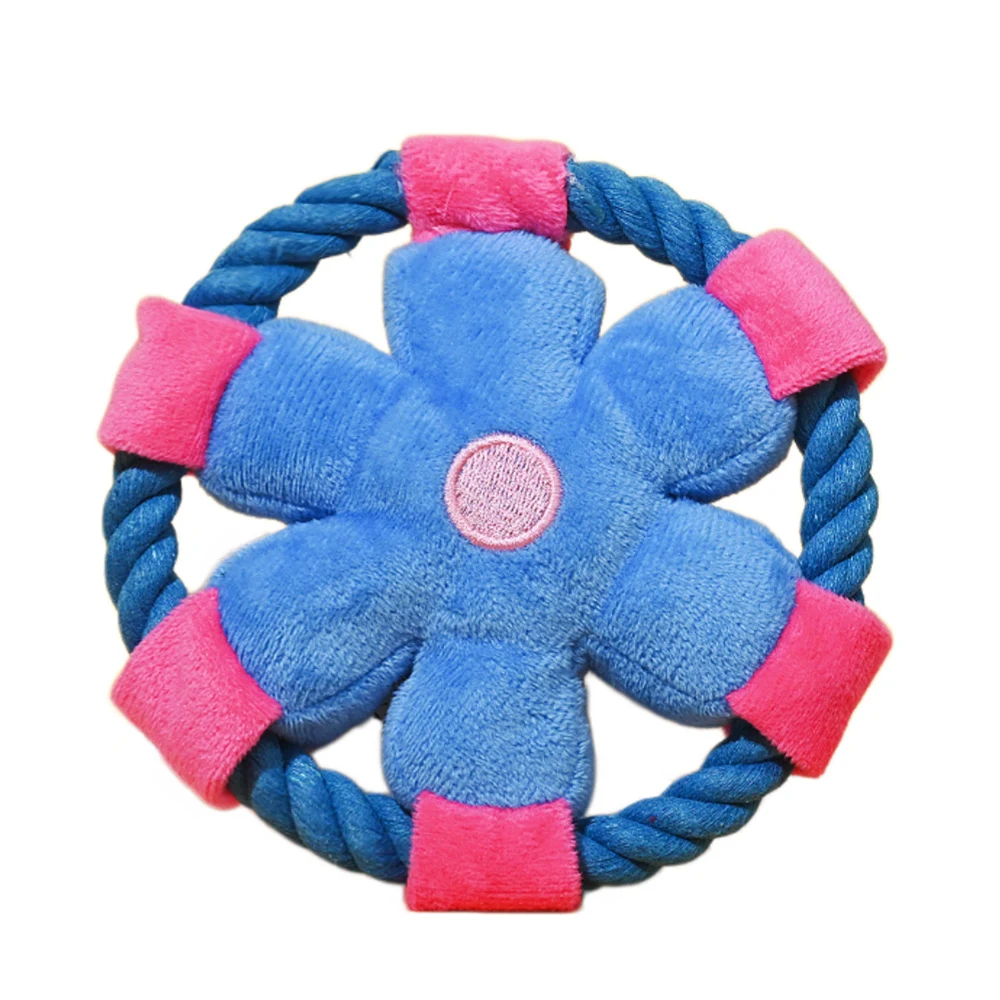
Customization
Move from reference styles to decisions on dimensions, materials, branding, samples and packing.
View Customization →If you only add two dog frisbees, which should they be?
There is no single assortment that suits every brand. A more useful approach is to build around what you already sell and avoid two products competing for exactly the same reason to purchase.
If you already sell plush dog toys
A plush squeaky disc can extend a familiar animal character into a different toy shape, but it may still sit close to your current plush assortment. If the aim is to enter outdoor fetch more clearly, a fabric flyer, foam ring or training-style disc could add a more distinct use occasion.
If you already sell a classic flying disc
Ask whether customers need another flying profile or a different play experience. An EVA-style ring may introduce a new grip shape and potential rolling play. A fabric or character-led disc may attract a different retail audience. But if the new style behaves almost identically to the existing one, a new colour or size may be the simpler extension.
If you are building a training-focused line
Start with the throwing and catching requirements instead of adding plush and novelty styles for variety alone. Compare disc sizes, weights and rim profiles only where they create a practical difference for the intended users. Do not describe a training disc as competition-approved without checking the relevant event rules.
| Current range | Useful addition to explore | Avoid adding without a clear reason |
|---|---|---|
| Mainly character plush toys | A functional fabric flyer, moulded ring or training-style disc | Another round plush toy with no distinct use |
| Mainly conventional fetch discs | A different ring grip, textile construction or verified specialty feature | A near-identical disc presented as a new function |
| Training-focused products | Distinct sizes or profiles tied to an intended activity | Novelty features unrelated to the range’s main purpose |
| Seasonal or gift assortments | Character-led designs with complementary use cases | Unrelated styles chosen only for matching colours |
These are starting points for assortment planning, not fixed buying formulas. The goal is to give each product a role that customers and sales teams can recognise.
What should a sample actually demonstrate?
Features that sound attractive in a product listing can require different kinds of evidence. Instead of treating all samples as one general quality check, connect each planned selling point to the finished product’s real behaviour.
| Planned selling point | What to check on the finished sample |
|---|---|
| Squeaky play | Whether the squeaker works as intended, its position and the surrounding construction |
| Soft catch | Rim feel, flexibility, how the dog can take hold of the disc and its intended use |
| Consistent flight | Shape, weight, throwing conditions and observed flight compared with the stated product goal |
| Rolling fetch ring | Whether the ring rolls as intended and remains easy to retrieve |
| Floating water toy | Whether the whole product floats and what happens after it gets wet |
| Foldable storage | How it folds, whether the construction allows it and the shape after reopening |
| Glow-in-the-dark play | Which component glows and the actual visibility after the specified light exposure |
| Tug-compatible rope feature | Grip positions, rope connections and whether the whole toy is intended for tug use |
| Competition use | Relevant dimensions, weight and a check against the requirements of the named event |
A material label or attractive photograph cannot prove all these features. For example, a brightly coloured disc is not necessarily glow-in-the-dark, and a foam ring is not necessarily buoyant. The sample review should match the precise claim a brand intends to make.
How do material and construction choices affect sourcing?
Confirm what the product is made from—not just what it looks like
For textile flyers, the useful details include the fabric type, rim construction, stitching, and any internal support. An Oxford-cloth option is not automatically plush, washable or able to float.
For moulded or foamed products, identify the actual proposed material before comparing quotations. EVA, ETPU, TPR, silicone and rubber should not be grouped under a single material specification. Different formulations and structures can affect the finished toy, while a photograph alone cannot reliably establish which one was used.
Make the design changes visible in the quotation
Changing a disc’s colour is different from changing its diameter, rim profile or construction. A sewn fabric version and a moulded version may also need different production steps and branding methods. Quotes are easier to compare when they refer to the same agreed dimensions, materials, decoration and packaging.
Think about packaging as part of the product
A textile flyer that is folded for packing should be checked after reopening. A training-style disc may need packaging that helps preserve its intended form. Mixed-material or rope-handle toys can occupy a different retail pack shape from a flat disc.
For multi-SKU ranges, this affects pack dimensions, how the product is presented to buyers and whether several styles can share a packaging format. No single packaging method should be promised for every frisbee construction.
What information helps with a first quotation?
A brand can begin with a reference photo and a short description of the intended product: whether it is for character-led play, regular fetch, water use or training. Add a target size, sales market and estimated quantity where available.
Then identify the decisions that still need comparing, such as a fabric versus moulded body, one ring size versus another, or a standard design versus a rope-handle variant. This gives the supplier a clearer starting point than asking for a price for a generic “dog frisbee”.
| Information to share | Why it matters for the project |
|---|---|
| Reference style and intended play | Identifies the right product family and main selling point |
| Target dimensions and expected feel | Helps define the finished construction and size options |
| Proposed material, if known | Prevents a foam, fabric or rubber product being mistaken for another |
| Claims that matter to your range | Directs sample comparison toward actual flight, sound, floating or other features |
| Colour, branding and retail pack | Clarifies what is being customised and costed |
| Sales market, quantity and SKU plan | Provides context for specifications, quotation and packaging discussions |
| Approved finished sample | Gives both sides a reference for final production requirements |
Questions buyers ask about dog flying discs
Are plush and fabric dog frisbees the same thing?
No. Plush usually describes a soft, pile-textured fabric or toy construction, while woven fabric and Oxford-cloth flyers may use flatter textile panels and a separate rim. The finished structure determines the actual play experience.
Is an EVA dog flying ring a rubber frisbee?
Not by material definition. EVA is a different polymer family from rubber. A flying ring and a flat disc can also differ in shape and gripping points, whatever material is used.
What does ETPU mean in a dog flying disc?
ETPU means expanded thermoplastic polyurethane. It is a material description, not proof of a particular softness, floating ability, flight distance or durability. Those depend on the finished product.
Is a brighter-coloured disc suitable for night play?
Colour alone is not enough. A glow-in-the-dark claim needs to be checked on the actual finished disc. Fluorescent-looking colours and genuinely photoluminescent components are not necessarily the same thing.
Can a flying disc also be sold as a chew or tug toy?
Only when the specific construction is intended for that use and the product’s selling points can be supported. A rope detail does not by itself establish tug suitability, and a rubber-like feel does not make every flying disc a chew toy.
Do we need a different SKU for every material?
No. Start with the role of each product in the assortment. Different colours can be variants of one style; a different material or shape deserves a separate SKU when it creates a meaningful product difference for the range.
Choosing dog frisbees for your next collection?
From plush and fabric flyers to EVA or other flexible rings, training-style discs and specialty constructions, PETMERO can discuss different sourcing and custom development directions for pet brands and wholesale buyers.
Share a reference design, the market you sell to, your intended play experience, approximate sizes and order plan. We can discuss suitable styles, material and construction options, sample expectations, branding and packaging for the specific project.